

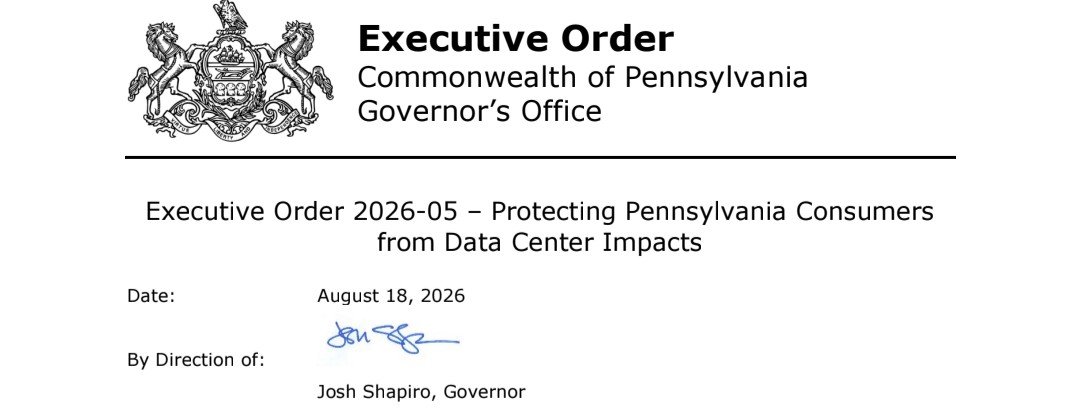
Pennsylvania Gov. Josh Shapiro signed an executive order Tuesday that immediately removes data centers from the state’s expedited permitting program, bars state agencies from signing nondisclosure agreements with their developers and attaches new conditions to a valuable equipment-tax exemption.
The order represents a sharp turn for an administration that championed Amazon’s planned investment of at least $20 billion in Pennsylvania data centers last year. But its practical effect is more measured than Shapiro’s forceful rhetoric suggests: Pennsylvania is not imposing a moratorium, and the order does not cancel permits already issued.
Instead, it creates two paths for large new projects, and makes the more favorable one expensive.
A fast lane with a higher price
The new framework applies to permit applications for projects expected to draw more than 25 megawatts at peak, enough electricity to place them among the state’s most consequential new power users.
Developers that sign a project-specific agreement under Shapiro’s GRID program can receive rolling environmental reviews. In return, they must accept legally enforceable commitments that can include:
- Paying for the additional power generation, transmission and distribution their projects require.
- Procuring increasing amounts of qualifying clean, always-available power, rising from 10% in 2027 to 32% in 2035, or making alternative-compliance payments.
- Holding additional public meetings and offering a community-benefits agreement.
- Meeting investment and employment benchmarks and submitting a water-management plan.
The state’s model agreement proposes steep penalties for violations: between $25,000 and $100,000 per megawatt per day for certain power-related failures, and $25,000 per day for other violations. Those figures are not fixed statewide rules; the template allows the state and each developer to negotiate project-specific terms.
Even developers taking this favorable route cannot receive qualifying state environmental permits until they show that the project is consistent with the local comprehensive plan and has obtained all required municipal zoning, subdivision, land-development and Home Rule approvals.
That is the order’s central local-control mechanism: existing municipal decisions now gate state permit action. It does not create a referendum or a new, freestanding local veto.
Refusing GRID remains possible
Shapiro described GRID as a mandatory set of requirements for operating in Pennsylvania. The signed order is narrower.
A developer can decline to sign a GRID agreement, but it then faces a slower and less predictable process. The Department of Environmental Protection will wait until the developer has secured local and specified water or wastewater approvals and submitted a consolidated package before beginning its review. The project loses rolling and guaranteed review, and cannot receive a newly sought state computer-equipment tax exemption.
That makes GRID refusal potentially costly, but refusal alone does not prohibit construction. The order also operates only within the governor’s existing legal authority and creates no privately enforceable right.
Shapiro’s energy advisers are separately directed to advocate before utility regulators for data centers to be curtailed before ordinary customers during periods of strain and to bear relevant reliability costs. The order itself does not enact those electricity rules.
A filter for a largely speculative boom
The administration says public databases contain more than 100 proposed data centers in Pennsylvania. Yet only 58 projects had engaged with the state environmental agency, 15 had applied for at least one permit and just five had secured every permit needed for an initial development phase.
Those numbers suggest the order is primarily a filter on a speculative pipeline, not a shutdown of an established industry. It raises the price of preferential treatment, slows developers unwilling to make binding commitments and gives municipalities more leverage before state permits move.
It also closes two practices that had become politically vulnerable. Shapiro’s administration previously promoted expedited permitting at a future Amazon campus, while state economic-development officials routinely used nondisclosure agreements when recruiting companies. Data centers now get neither secrecy nor the fast track.
The result is a substantial policy reversal, but not the outright blockade implied by the governor’s description of the rules as the nation’s strictest. Pennsylvania has chosen conditional development; New York, by contrast, has paused certain state environmental permits for new hyperscale data centers for as long as a year.
Shapiro’s order leaves Pennsylvania open to new projects, but only after developers show more of their plans, secure local approvals and decide whether faster state review is worth accepting enforceable obligations for power, water and community impacts.