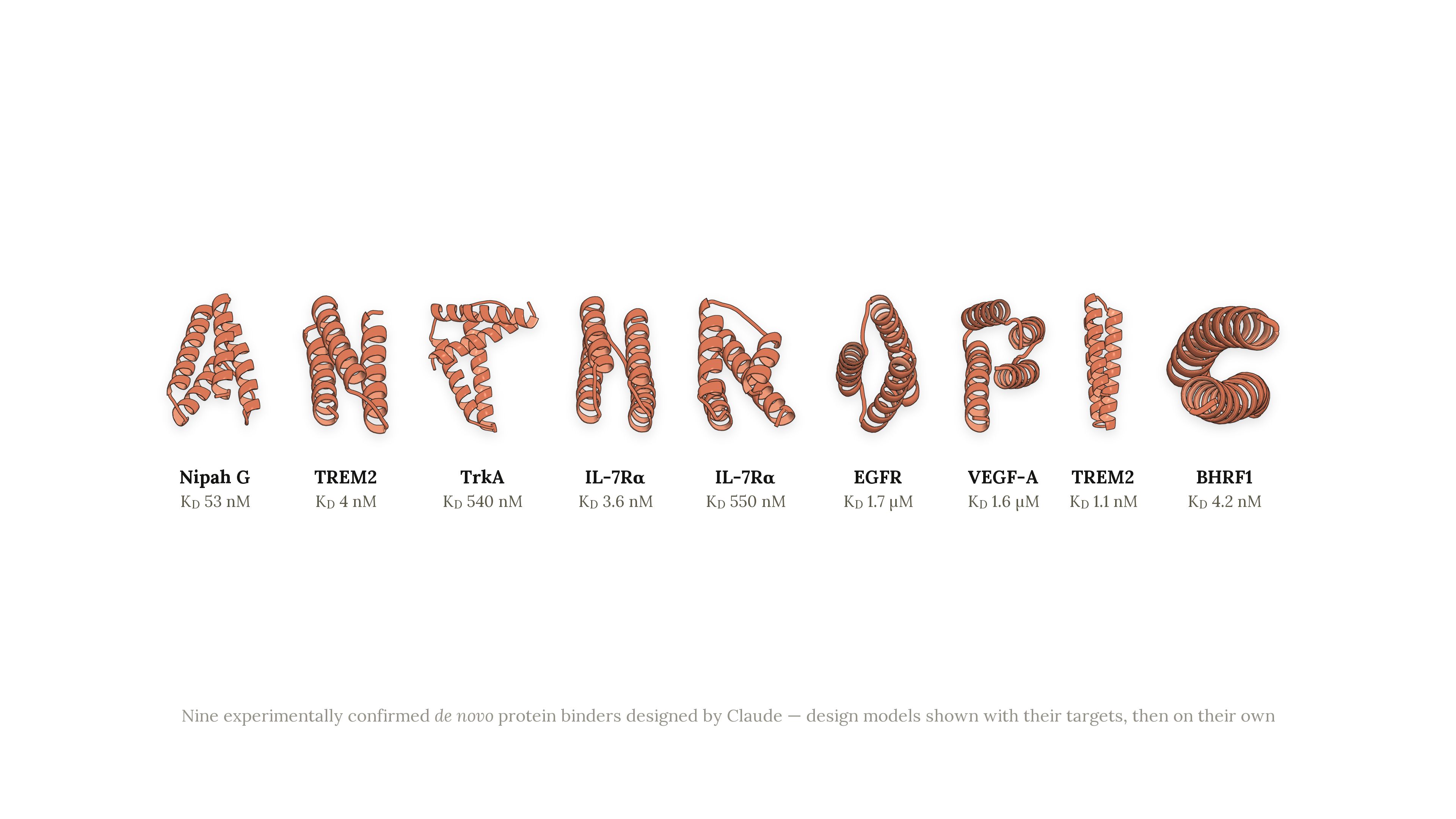
Anthropic says Claude autonomously ran protein-design campaigns that produced confirmed binders for 14 of 15 evaluable biological targets, demonstrating that a general-purpose AI can orchestrate a technically demanding early stage of drug research at substantial scale.
Two independent laboratories, Adaptyv Bio and Twist Bioscience, built and tested the small proteins. Among 1,320 designs with interpretable assays, 354 bound to their intended purified targets, a 26.8% hit rate. The broader release contains 1,440 designs, each 50 to 120 amino acids long.
That is the important result, but “autonomously” needs unpacking. Claude did not develop a drug from a blank chat window. Human researchers supplied an extensive protocol, the targets, scientific literature, specialist protein-design models, computational tools and GPU allowances that could reach thousands of H100-hours in a session. After kickoff, however, Anthropic says Claude chose where on each target to bind, operated the tools, filtered candidates and selected which designs should be synthesized, without further scientific direction.

Many drugs work by binding to a specific target in the body and blocking or changing what it does. An important first step in the drug development process is designing a molecule that can bind tightly to its target. Traditionally, that's meant weeks or months of expert work per target, sifting through a large number of candidates to identify the few that work. We wanted to test if Claude could successfully design novel protein binders from scratch (also called de novo design). With a protein design prompt written by a human expert, Claude autonomously designed protein binders against 14 out of 15 targets. We then worked with Adaptyv Bio and Twist Bioscience, who independently built and tested the proteins Claude designed.
The experiment suggests AI can take over more of the coordination and judgment involved in computational protein design, compressing work that can occupy specialists for days or weeks into agent sessions lasting 24 or 48 hours. It does not show that Claude can independently discover a medicine.
What the AI actually made
A protein binder is a molecule shaped to attach to a particular site on another protein, somewhat like a key fitting a lock. Binding can block a protein, stabilize it or help recruit other biological machinery. Many medicines work through some version of that interaction, which makes finding a strong binder a useful starting point.
It is still only a starting point. These experiments measured whether the designed proteins attached to purified targets in laboratory assays. They did not establish that the binders alter cells in the desired way, avoid unintended targets, survive inside the body, reach the right tissue or remain safe and effective in animals or people.
Some designs bound tightly. A TREM2 binder was reported at a dissociation constant of 1.1 nanomolar, while other confirmed designs targeted proteins including IL-7Rα, Nipah G, EGFR and VEGF-A. A lower dissociation constant generally means tighter binding, although affinity alone does not make a molecule therapeutically useful.
The strongest evidence comes from the physical testing. Adaptyv and Twist independently synthesized designs and ran binding assays, and Anthropic released sequences, expression measurements, predicted structures, raw assay traces, assessments from both vendors and records of the computational workflow. That gives outside researchers more than a polished success chart to inspect.
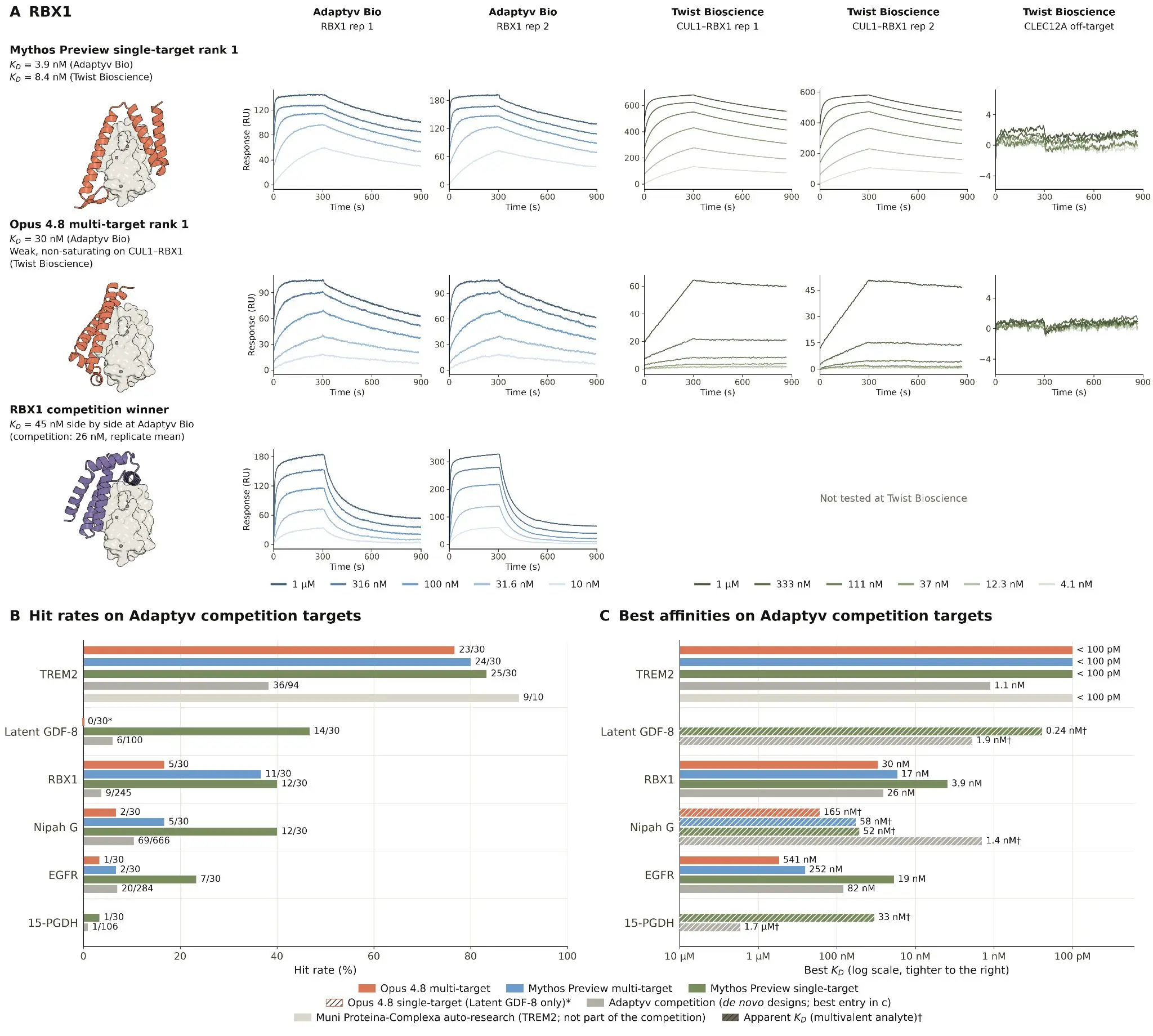
The two labs did not always reach identical conclusions. For an RBX1 design, for example, both reported binding but measured different affinities. Another design looked convincing at Adaptyv while producing weak, non-saturating binding at Twist. Such disagreements are normal reasons to use independent assays rather than treating one curve as final proof.
A strong result with a slippery benchmark
Anthropic reports pooled hit rates ranging from roughly 22% to 35%, depending on the model and campaign setup. Its released total, 354 hits from 1,320 interpretable tests, sits inside that range. Claude found at least one binder for every evaluable target except one.
Anthropic contrasts those results with typical success rates of 10% to 15%. That comparison is suggestive, not decisive. Protein-binder studies use different targets, screening methods, assay thresholds and definitions of a “hit.” Adaptyv has warned that the field’s lack of standardization makes results from separate reports difficult to compare, and the Boltz team has put the central assay problem plainly: an ambiguous response can show that something is interacting without proving that one design cleanly bound one target.
Even so, this is not merely a simulation benchmark. Hundreds of designed proteins were made and tested, and a meaningful fraction physically interacted with their targets. Anthropic says the 354 confirmed binders amount to about 46% as many as appear in two large public collections it cites, though those collections span roughly 5,700 designs across 40 targets and were not evaluated under one standardized assay.
The notable advance is therefore less “a chatbot invented drugs” than “an AI agent managed a productive protein-design pipeline.” Claude combined existing structure-generation and sequence-design systems, evaluated their outputs and made experimental selections at a scale that would ordinarily demand sustained attention from expert teams.
Anthropic says it is now working toward models that can run more of the development process across antibodies, small molecules and other drug types, and plans an access program for scientists. Each additional step will be harder to validate and more consequential than finding a purified-protein binder.
Importantly, protein binders are not drugs. Designing a high-affinity binder is just the first step in the process of developing a drug-like molecule. Even designing a drug itself is just one phase out of the many required to establish that a drug is safe and effective before making it available to people. However, this establishes a strong foundation to work from, and we are building on it by teaching Claude to run the entire development process end-to-end for every major type of drug molecule—from antibodies to small molecules.
For now, Claude has produced unusually concrete evidence of scientific agency: not a finished therapy, but hundreds of physical molecules that behaved in the lab closely enough to merit further work.