
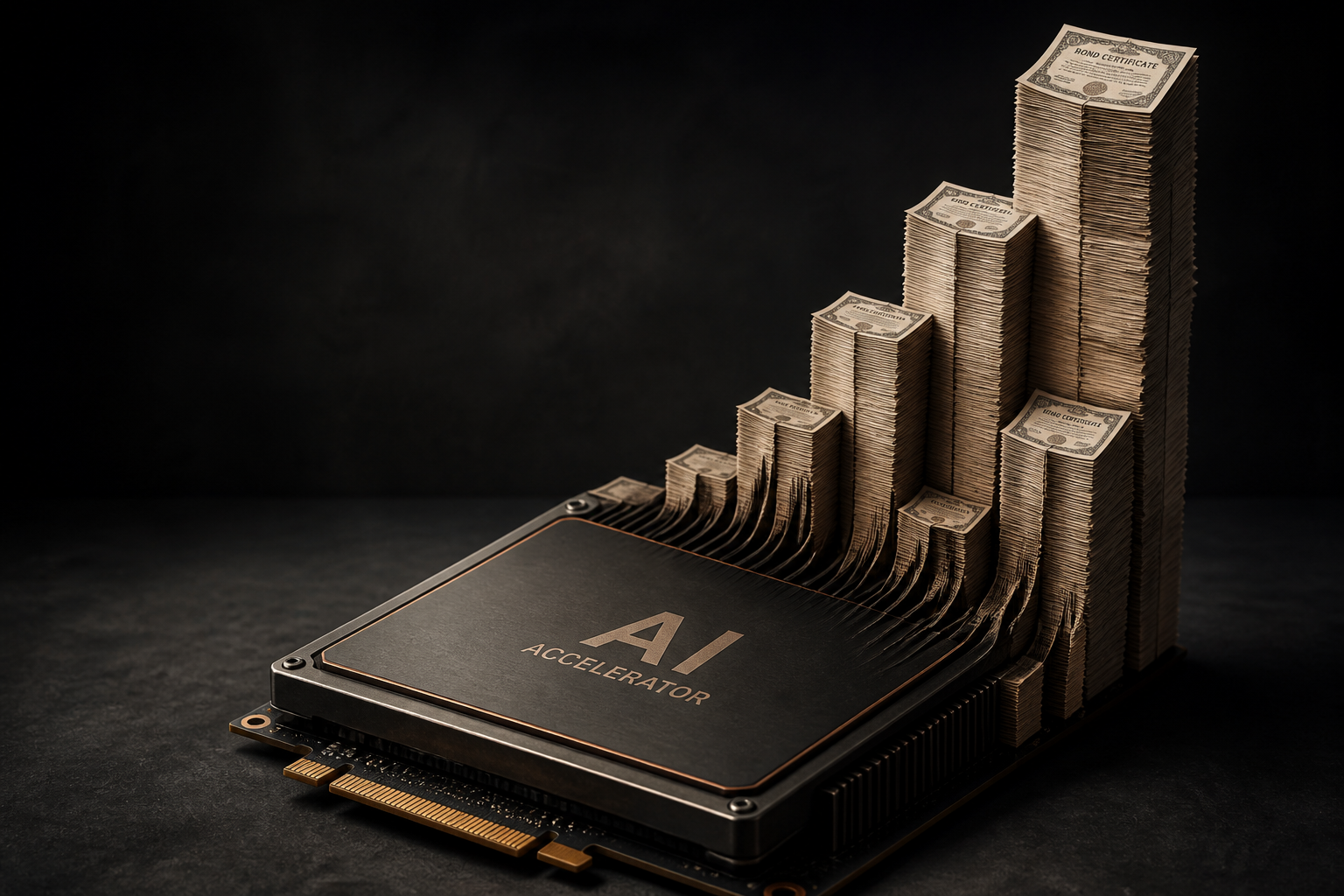
An artificial-intelligence lab could fill data centers with cutting-edge chips while someone else borrows the money. If the bet sours, investors may be left trying to sell hardware that can lose value faster than a car. Who owns the risk when the laboratory does not own the debt?
That question sits inside Broadcom’s talks with lenders. The chipmaker is discussing more than $60 billion in debt for chips and related infrastructure benefiting Anthropic and other AI developers.
If the package follows Broadcom’s earlier model, the developers could secure vast computing capacity without borrowing directly. Investors, and, depending on its guarantee, Broadcom, would carry more of the downside if payments stop or the chips lose value. No financing has been agreed, and its final size, borrower, guarantee and repayment terms remain open.
A $35 billion model scales up
Only two months ago, Apollo, Blackstone and a group of banks completed an initial $35 billion Broadcom financing for Anthropic. The transaction was designed to deliver computing capacity over several years.
Broadcom executive Won Kim said then that demand for AI computing was growing faster than traditional capital markets could accommodate. The latest talks show how quickly the proposed answer has expanded.
On Aug. 4, Bloomberg reported that a second package had initially been proposed at no less than $36 billion. The current discussions exceed $60 billion. One possible structure would place $60 billion to $70 billion in debt that gets repaid first, with roughly $30 billion in a lower layer that absorbs losses sooner. Together, the package could approach $100 billion, almost three times June’s deal.
The debt can move. The risk cannot.
The June transaction shows why the structure matters. A separate financing company borrowed to buy chips, then leased computing capacity to Anthropic. Anthropic made lease payments rather than taking the loan directly, and those payments serviced the debt.
Broadcom protected senior investors against some losses. Junior investors depended much more heavily on what the chips could fetch if the financing company had to sell them.
That division turns technological change into financial risk. AI chips can be displaced by newer generations within two or three years. If demand disappoints or a customer stops paying, the equipment securing the debt may be worth far less just when investors need it most.
This is not free money. It is a way to build sooner by moving part of the financing, and part of the risk, to separate companies, banks, investment funds and potentially Broadcom. The precise split remains undecided, but the answer to the opening question is already visible: AI labs can obtain the computing power without taking all the debt directly, while the wager on future demand spreads far beyond them.