Z.ai Made Its Coding Model Far Better Without Making It Bigger
Z.ai Made Its Coding Model Far Better Without Making It Bigger
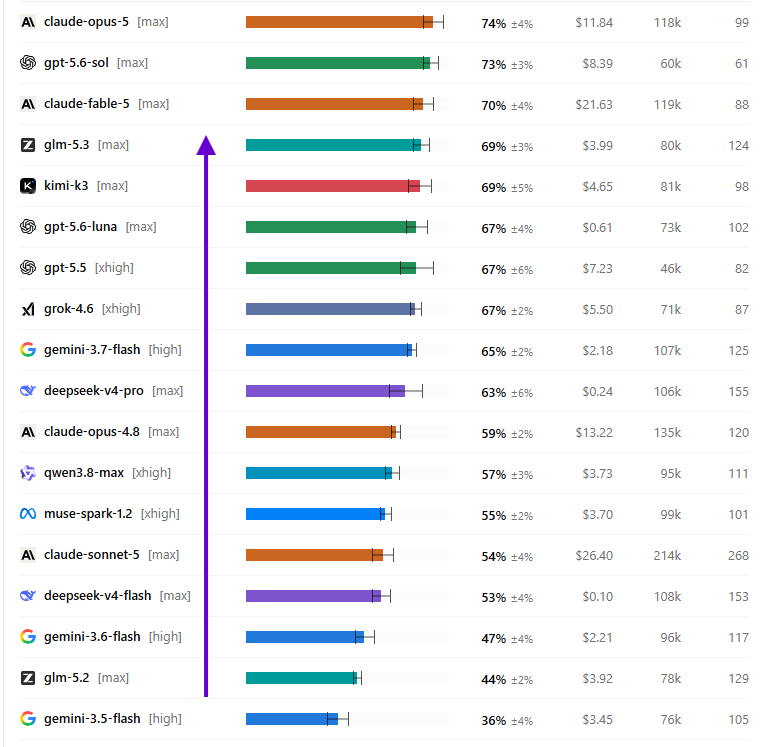
After one more month of training, GLM-5.3 jumped from completing 44% to 69% of long software jobs on an independent benchmark.
The short version
Z.ai gave the same 743-billion-parameter base more training on realistic, multi-step coding jobs, using automated grading.
On an outside test, GLM-5.3 completed about 69% of jobs, up from GLM-5.2’s 44%.
It nearly matched Claude Fable 5 there at under one-fifth the average run cost, though broader tests cost more.
Illustration · Onset News
Latest update
GLM-5.3 reaches Arena’s WebDev frontier
A second outside evaluation broadens the evidence beyond repository repair. Arena scored GLM-5.3 Max at 1,597 points on multi-step front-end development, ranking it eighth overall, and placed it on the price-performance frontier at a blended $3.65 per million tokens.
Arena says the model would rank second among open models once Z.ai releases its weights. This does not prove post-training caused the improvement, but it shows the stronger performance extending beyond DeepSWE’s fixed engineering tasks into a separate coding arena.
Full story
Z.ai launched GLM-5.3 on Aug. 14 and put its API live four days later. Its claim is simple: the parameter count did not change, but the practice did. An outside leaderboard records the jump.
DeepSWE is not a code-completion quiz. It gives every model the same agent and 113 original software-engineering jobs that require many steps. The new result amounts to roughly seven jobs finished in ten, up from fewer than half.
via @haider1
GLM-5.3 finished essentially alongside Claude Fable 5, 69%±3% versus 70%±4%, at less than one-fifth the average cost per run.
The work changed, not the size
Z.ai says GLM-5.3 reuses GLM-5.2’s 743-billion-parameter base, architecture, and total and active parameter counts. During the extra month, it trained the model on runnable jobs designed to resemble work that unfolds over many steps, rewarding successful attempts.
The company describes something like a task factory. One system turns patterns from real engineering into executable problems with details to uncover and dependencies across many steps. Another checks that each problem is solvable, while automated graders test the result before it becomes a pass-or-fail training signal.
Z.ai has not disclosed how many tasks it created, how much extra computing it used, the training logs or a test isolating this curriculum from its other reinforcement-learning changes, so the evidence does not establish that task creation alone caused the jump.
Cheap here, hungrier elsewhere
On DeepSWE, the average run cost barely moved, from $3.92 for GLM-5.2 to $3.99 for GLM-5.3. But Artificial Analysis measured about 20% more output and 1.5 times the cost per task on its broader evaluation. The upgrade is a notably cheap high-scoring option, not an automatic reduction in tokens or cost.
Developers can use GLM-5.3 through Z.ai’s Coding Plan, ZCode and API, which carries the same per-token price as GLM-5.2. Public weights are still forthcoming.
GLM-5.3 is an early example of AI progress shifting toward systems that continually make realistic practice, grade it reliably and feed the result back into training. The model’s size held still; the training ground moved.