
On Jan. 25, 2022, a random assignment put 16-year-old Chase Nasca among the TikTok users who would not receive a new feed safeguard. An internal TikTok report later said its protections against repetitive content did not take effect on his account “by design,” according to Bloomberg.
Over the final two weeks before Chase died by suicide that February, TikTok reviewed 7,563 videos served to him. Nearly 10% violated its rules against promoting or normalizing suicide or self-harm. Seventy-three percent carried themes including mental-health struggles, breakups, suicide awareness and survivor testimony.
The evidence establishes Chase’s assignment and what TikTok recommended to him, not that the experiment caused his death; no court has made that finding.
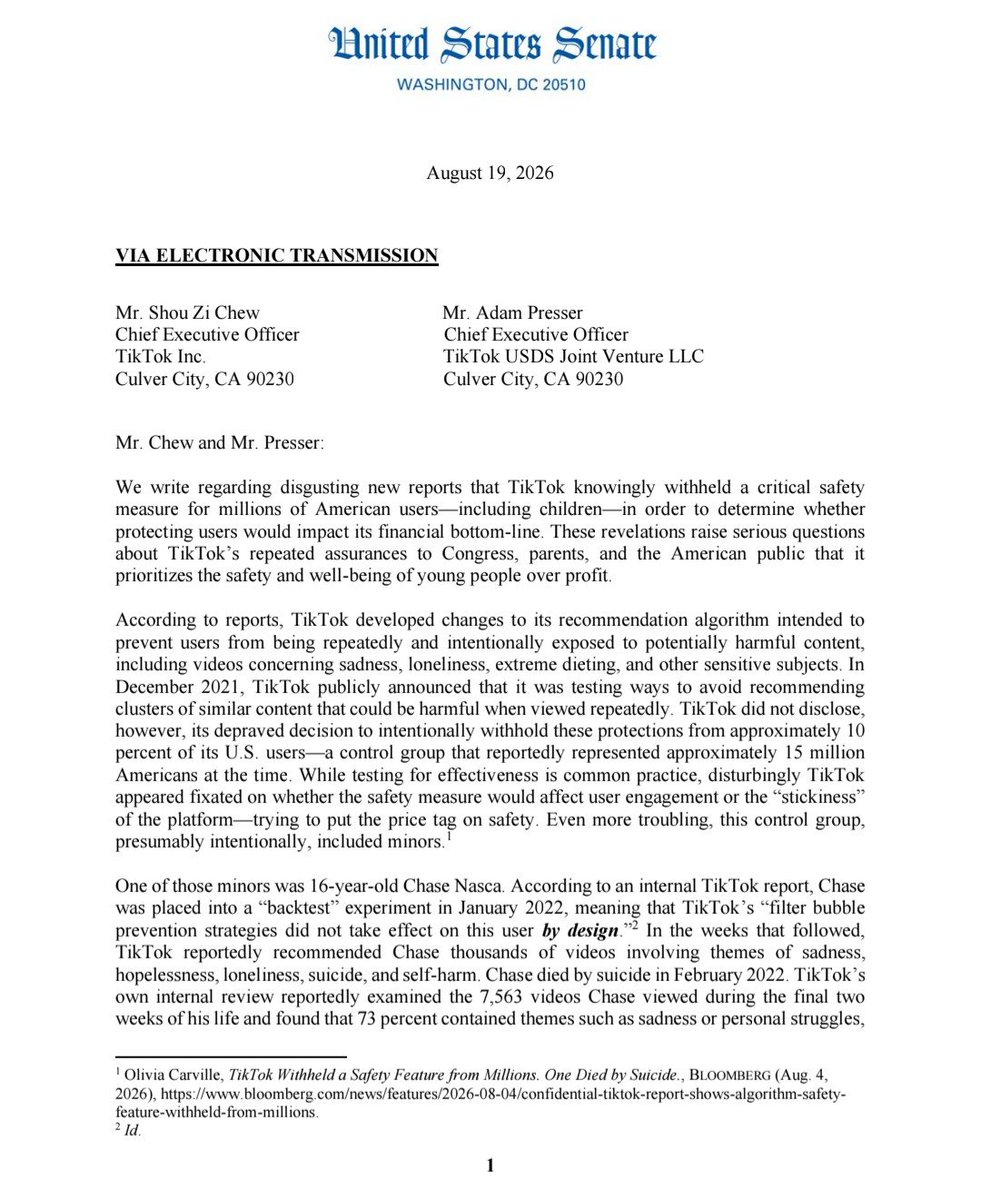
Now the experiment is a congressional accountability test. On Aug. 19, Senators Marsha Blackburn and Richard Blumenthal sent a four-page letter to TikTok CEO Shou Zi Chew and Adam Presser, who leads TikTok’s U.S. data-security joint venture. They demanded answers by Sept. 1.
Ten percent is not a small test
TikTok announced in December 2021 that it was developing a way to interrupt long runs of videos about subjects such as sadness, loneliness, breakups and extreme dieting. The protection was specific but consequential: it was meant to stop the recommendation system from piling one troubling theme onto the next.
Bloomberg later reported that TikTok gave the new setup to 90% of its U.S. users while leaving roughly 15 million people on the older system. That holdout let the company measure whether the safeguard reduced engagement, or the app’s “stickiness.”
TikTok told Bloomberg that comparing the two versions was a routine check of a safety change. It said it has since refined its testing practices, without detailing those changes. The company did not immediately respond to TechCrunch about the senators’ letter.
TikTok’s internal report reportedly recommended cutting future holdouts below 1% and shortening tests from six to 12 months to seven days. Even less than 1% of TikTok’s U.S. audience could still mean at least 1.8 million people.
Who carries the experiment
Blackburn and Blumenthal want to know how minors entered the holdout, which employees approved or knew about it, and what records TikTok kept. They also requested details of every U.S. test since 2019 in which the company withheld, delayed or reduced a safety measure.
The letter is an oversight request, not a subpoena or enforcement action. But its scope turns one reported experiment into a larger question about how TikTok governs its automated feed.
That is also why this belongs in the wider AI-governance story. At TikTok’s scale, a control group is not an abstract slice of traffic. It is millions of people placed on the less-protected version while a company measures a business outcome.
TikTok has until Sept. 1 to explain who decided that one user in ten, including children, would carry that risk.