

The trouble began at 1:28 p.m. UTC on Aug. 17. Errors and delays spread across the tools developers use to track issues, review code, connect other software, run automated workflows through GitHub Actions and work with Copilot. At the worst point, about one in five web requests and connections from other software failed; errors on code-archive and raw-file downloads reached roughly half.
GitHub kept the incident open for 7 hours and 47 minutes, though the disruption was uneven. Most services recovered by 4:36 p.m., Actions by 6:03 p.m., and the service that issues Copilot access tokens by 9:02 p.m.
The failure is a snapshot of GitHub’s AI-era scaling problem. GitHub says coding agents are helping drive record growth in repositories, pull requests, software interfaces and automation, forcing it to plan for 30 times today’s scale. It has not disclosed what share of this traffic peak came from agent workflows, and neither AI nor Azure can be named as the cause.
According to GitHub’s account, a small traffic-handling component attached to a service in its Central US facility reached the number of simultaneous requests it could handle. The system meant to add capacity was watching the host service instead of that component, so it missed the approaching limit.
Slow replies then triggered retries, the same requests sent again, piling more work onto load balancers that distribute traffic across servers. A defect in Visual Studio Code turned delays at one Copilot endpoint into a roughly tenfold surge, lifting traffic from its usual 7,000, 9,000 requests a second to 70,000, 100,000.
GitHub had already added vast capacity
Since April, GitHub says monthly commits have more than doubled from 1.4 billion to 2.9 billion. It added more than three million processor cores and 120 petabytes, about 120 million gigabytes, of high-speed storage, installing all the hardware its existing data centers’ power supply could support. The Aug. 17 failure showed why raw capacity is insufficient when scaling controls watch the wrong bottleneck.
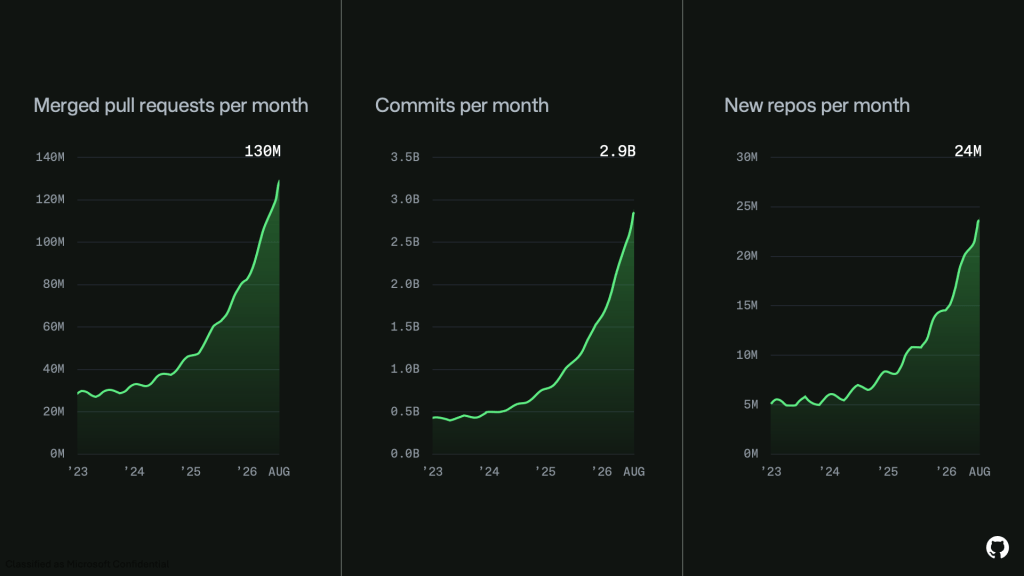
That miss matters on a platform GitHub says has more than 180 million developers. It was also the second serious August incident: on Aug. 6, Actions was degraded for more than nine hours, and 71% of workflow runs suffered infrastructure failures at the peak. GitHub had already acknowledged in March that it was not meeting its own availability standards.
GitHub says it will correct and audit the scaling rules, limit retries, fix the Visual Studio Code behavior, improve load-balancer monitoring and strengthen failover to other regions. Those changes are still underway, with no deadline given for most of them.