
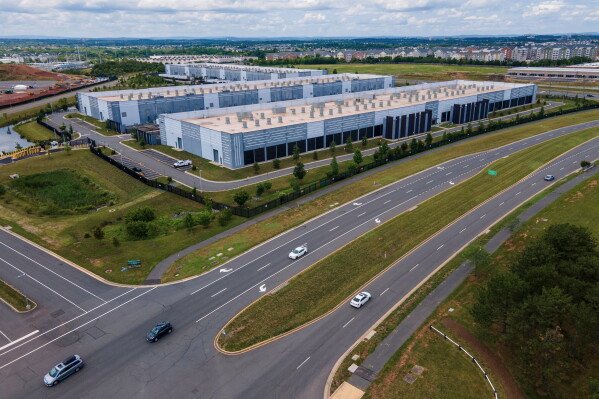
President Donald Trump stood at the White House this week and imagined the choice facing a mayor or governor. Given the chance to land an AI plant or data center, he said, “I would absolutely want it” for the jobs and tax revenue.
The voters those officials answer to have moved sharply the other way.
Heatmap Pro and Embold Research surveyed 2,045 registered voters from Aug. 8 to 13. It described data centers as facilities housing the servers behind the internet, apps and artificial intelligence, then asked whether people would support one near their home.
Three-quarters opposed it. Just 15% supported it. More than 60% were strongly opposed, while 4% were strongly supportive.
A year earlier, the same survey series posed the same question to a fresh sample and found a virtual tie: 44% support and 42% opposition. A roughly even result has become five opponents for every supporter.
Every line points down
Republicans were the lone supportive party group last August, with supporters outnumbering opponents by 14 points. Now opponents lead by 43 points among Republicans, 65 among independents and 75 among Democrats.
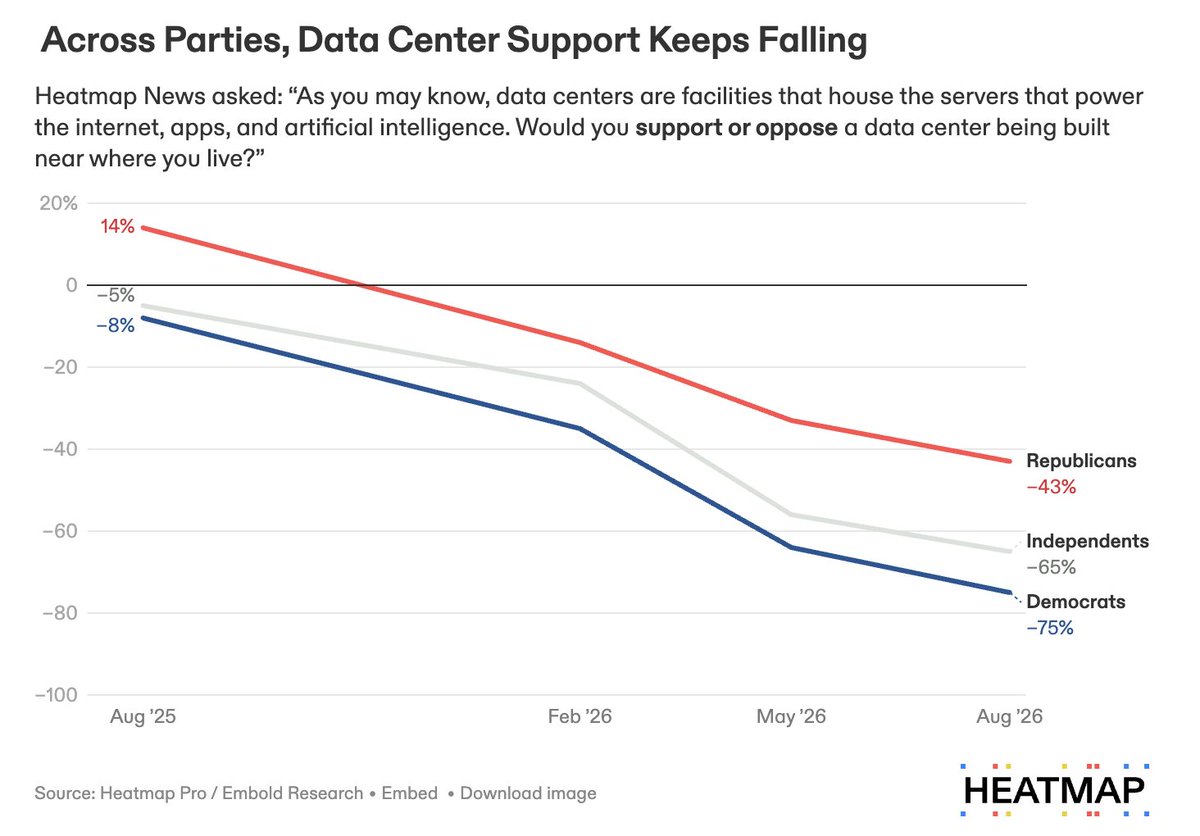
Those figures are net margins, the difference between support and opposition, not the share of each party that opposes construction. But the direction is unmistakable: no partisan constituency remains on the supportive side.
This is bigger than one poll. Gallup found 71% opposition in March, and Fox found 70% in July. Yale and George Mason researchers measured 58% opposition in April. Annenberg, which returned to nearly the same panel of adults, saw opposition rise from 49% to 61% between its early- and midyear surveys.
The exact national level remains unsettled: Heatmap has not published poll-specific recruitment and weighting details, and an AI Policy Institute experiment cut opposition from 57% to 38% when safeguards were promised.
That sensitivity gives residents leverage over the bargain. When Gallup asked opponents why they objected, half mentioned heavy resource use, with water and energy recurring most often. Supporters saw the other side of the trade: two-thirds cited economic benefits, especially jobs.
The demand behind those concerns is growing. Data centers consumed about 4.4% of U.S. electricity in 2023, according to the Energy Department and Lawrence Berkeley National Laboratory. By 2028, their share could reach 6.7% to 12%, as much as roughly one-eighth of the country’s power.
The welcome now has conditions
Governors are already behaving as though public resistance carries political weight. In Pennsylvania, Gov. Josh Shapiro removed large data centers from the permitting fast track and tied favorable treatment and tax benefits to new energy and community commitments.
Texas ordered work on protections for ratepayers and held some projects while that process moved forward. Arizona paused new data-center tax exemptions, while Illinois halted new exemptions until it develops standards.
The backlash has also reached campaigns. The Senate Republicans’ campaign arm warned that anger over data centers could cost the party an Ohio seat, even as Trump continues to present the build-out as essential to jobs, tax revenue and the competition with China.
That is the new constraint on the AI boom. The industry is racing to secure electricity, land and water; the polls show it now has to secure permission, too.