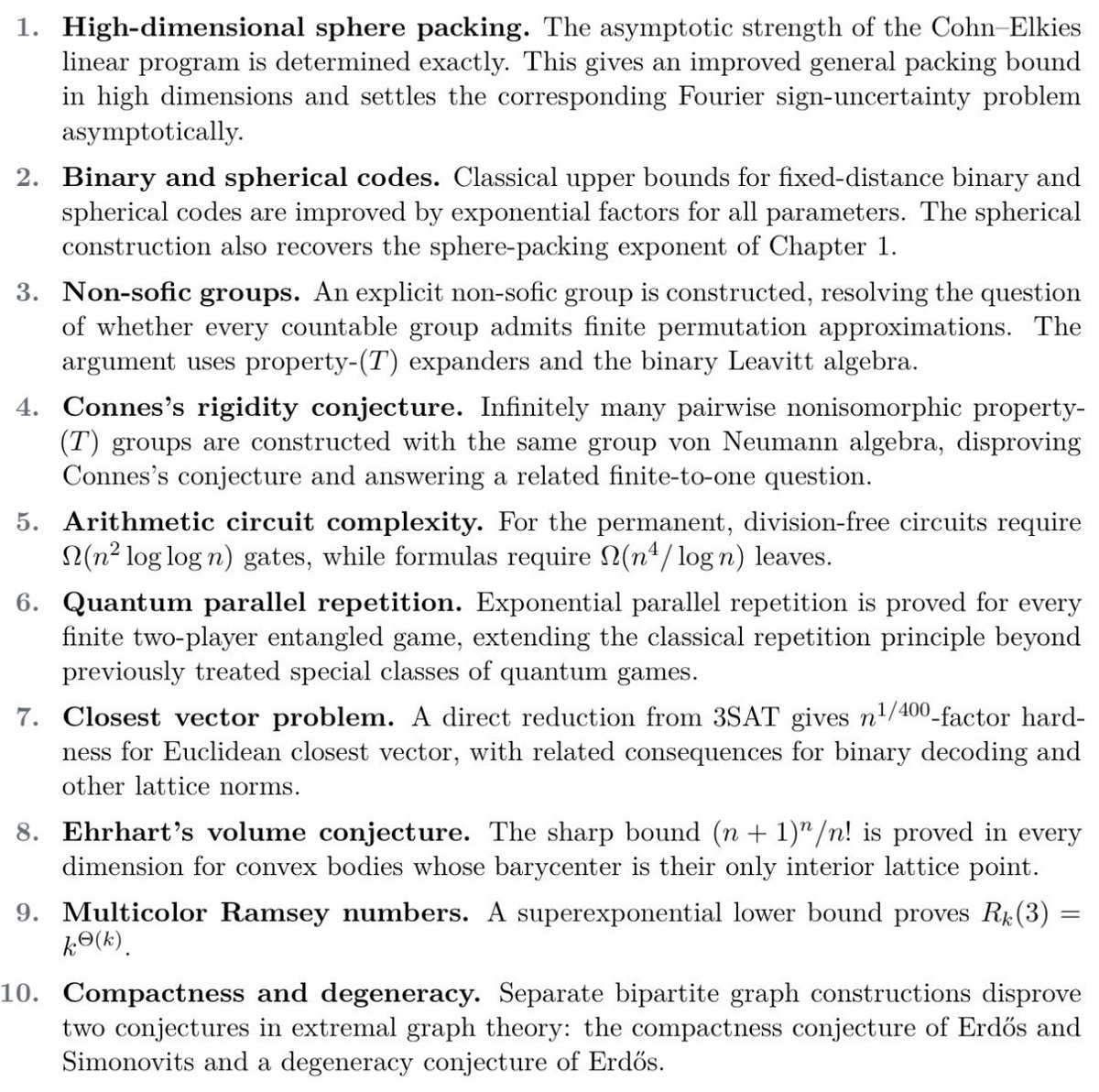
OpenAI says an internal version of Astra, its next major model, produced ten advances across mathematics and theoretical computer science. The company says the tokens used to find the solutions would cost roughly $2,000 at rates for its existing Sol models.
The claim is extraordinary because of the breadth and age of the problems. OpenAI said each had gone at least a decade without progress on its main result, and most had been stuck longer.
The package does not mean Astra simply solved ten problems. It mixes claimed resolutions and disproofs of conjectures with improved mathematical bounds. The results remain OpenAI’s claims. OpenAI’s announcement, paper and repository name no outside mathematicians who checked the ten results, though the repository includes instructions for independently checking the formalizations.
Two results show the scale of the claim
In group theory, the paper claims to construct an explicit non-sofic group, resolving whether every countable group can be approximated in a particular way using finite permutations.
In high-dimensional sphere packing, it claims the first improvement to the general exponent since 1978.
The arrival of claimed results in such different fields makes the package more striking than a single model-generated proof.
The proofs can be inspected
OpenAI published manuscripts and a public repository containing Lean formalizations for all ten results. Lean is software that mechanically checks whether a proof follows from its stated premises.
That is stronger evidence than persuasive chatbot prose, but it does not independently establish that the formal statements precisely capture the claimed breakthroughs. Experts still need to inspect the definitions, assumptions and connection between the checked theorem and the informal result.
OpenAI said humans prepared the arguments as manuscripts with help from the model, which then formalized them in Lean.
The $2,000 figure is not money OpenAI says it spent. It is what the solution-finding tokens would cost at Sol API rates, not the full cost of developing or running Astra, selecting the problems, preparing the manuscripts, creating the formalizations or reviewing the work.
Outside scrutiny is the missing test
In May, OpenAI said an internal model had disproved the Erdős unit-distance conjecture and that external mathematicians checked the proof. OpenAI’s Astra announcement, paper and repository name no comparable outside mathematicians who checked the ten new results, though the repository includes instructions for independently checking the formalizations.
A June declaration endorsed by the International Mathematical Union warned that automated systems can produce plausible but unreliable arguments that are hard to distinguish from correct proofs. It also said press releases and blog posts cannot replace peer review or scrutiny by the mathematical community.
OpenAI has made the claims open to inspection by releasing manuscripts and Lean certificates. For now, the plain conclusion is that Astra has produced ten substantial, mechanically checkable claims whose significance still needs independent expert scrutiny.
Sources (8)
- Ten Advances in Mathematics and Theoretical Computer Science cdn.openai.com
- Cdn.openai.com cdn.openai.com
- GitHub - openai/ten-proofs: Lean certificates accompanying proofs in mathematics and theoretical computer science · GitH github.com
- List of open questions a3nm.net
- Did A.I. Really solve a math problem that mathematicians couldn't? slate.com
- Ten advances in mathematics and theoretical computer science | OpenAI openai.com
- Leiden Declaration on Artificial Intelligence and Mathematics leidendeclaration.ai
- An OpenAI model has disproved a central conjecture in discrete geometry | OpenAI openai.com