

Grok Bot, the AI agent from Elon Musk’s SpaceXAI, can now get its own email address, which it can use to sign up for services, contact businesses and schedule meetings for the people it works for, the company said on Friday.
The company said the feature is reaching users starting Friday. To get an address, a user asks the bot for one, and the bot checks whether the name is free. Addresses end in @mail.grokbot.com. At companies, an administrator has to switch the feature on for the team first.

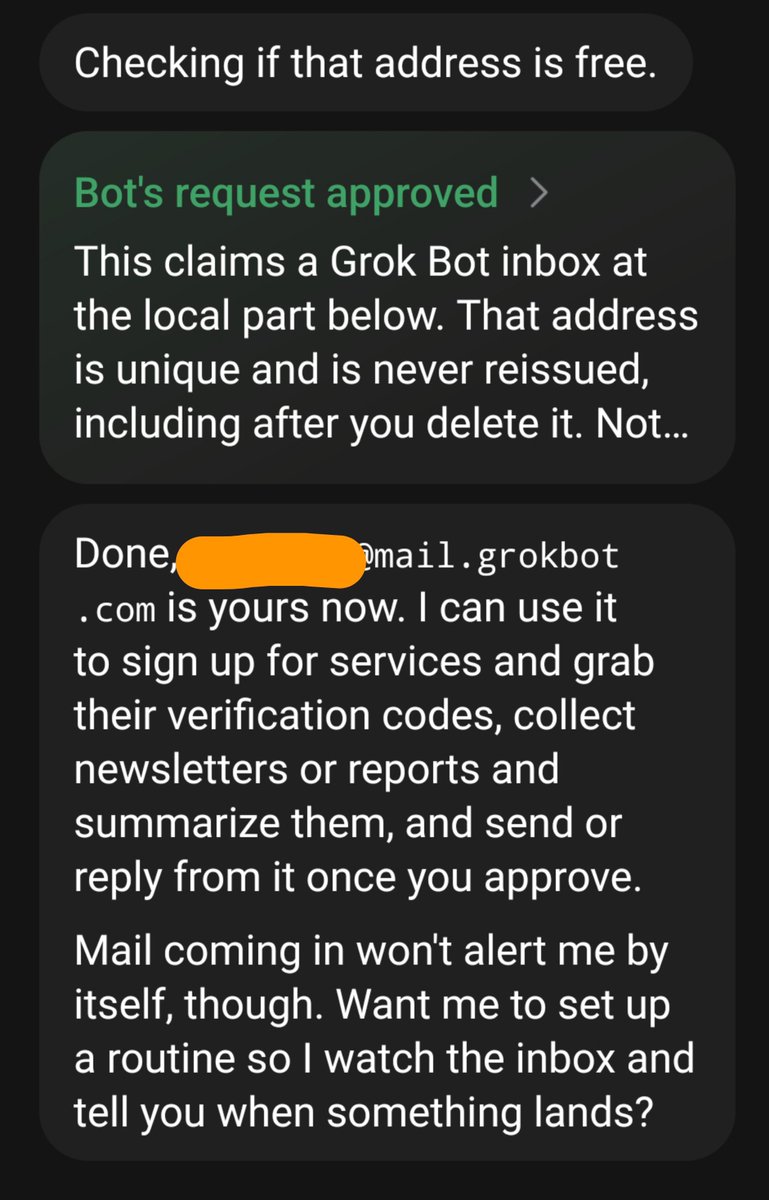
Just gave my Grok Bot its own email address and it set it up by itself This is bigger than it sounds. Now my Bot has its own inbox so it can sign up for services, email businesses and book time with people without touching mine @thsottiaux brace yourself @poteto typing... 🫣
Grok Bot is not the Grok chatbot. It is a separate product, released in August, that runs on its own computer in the cloud, logs into a user’s apps and websites, and keeps working after the user closes their laptop. It is included in expensive subscriptions such as SuperGrok Heavy and Cursor Ultra, which costs $200 a month. Until now it could handle email only through a Gmail account the user connected.
Why it matters. Most AI assistants that handle email work inside your own inbox, which gives them your private messages and password-reset emails, and lets them send mail in your name. A separate address keeps that apart. The bot can take a verification code from a new website, receive a vendor’s reply or collect newsletters without ever seeing your personal mail, and the people it writes to can tell the message came from a bot.
In a screenshot one user posted, the bot said it would send or reply from the address only after the user approved, and that a deleted address is never given out again. SpaceXAI has not published any documentation. It has not said which plans include an inbox, how much mail a bot can send, or how long messages are kept.
The risk. Anyone can write to an inbox. A stranger could hide instructions in an email to trick the bot, a known weakness of AI agents called prompt injection. And because an inbox that receives verification codes can be used to take over accounts, losing control of the bot’s address could be serious.
The race. Grok Bot is not the first. On Thursday, Google said its new Gemini agent for businesses can get its own work email address, calendar and listing in the company directory, and OpenAI is building agents of its own. The question these companies have to answer is no longer whether an AI should have an identity of its own online, but how much it can be trusted to do with one.