



Meta on Monday released Muse Wonder and Muse Wonder Full, two artificial intelligence models built to power agents, which are AI systems that carry out tasks for people. The company calls them its most capable models so far.
Meta says the models lead on "personal and professional agentic tasks," meaning work like sorting out an insurance claim, reading a lease or making sense of someone's finances, along with writing software. It is pitching two features. "Active Memory" carries what a user cares about from one conversation to the next. "Active Focus" keeps the model working on a hard task, trying other approaches when it gets stuck and checking in before it does anything important.
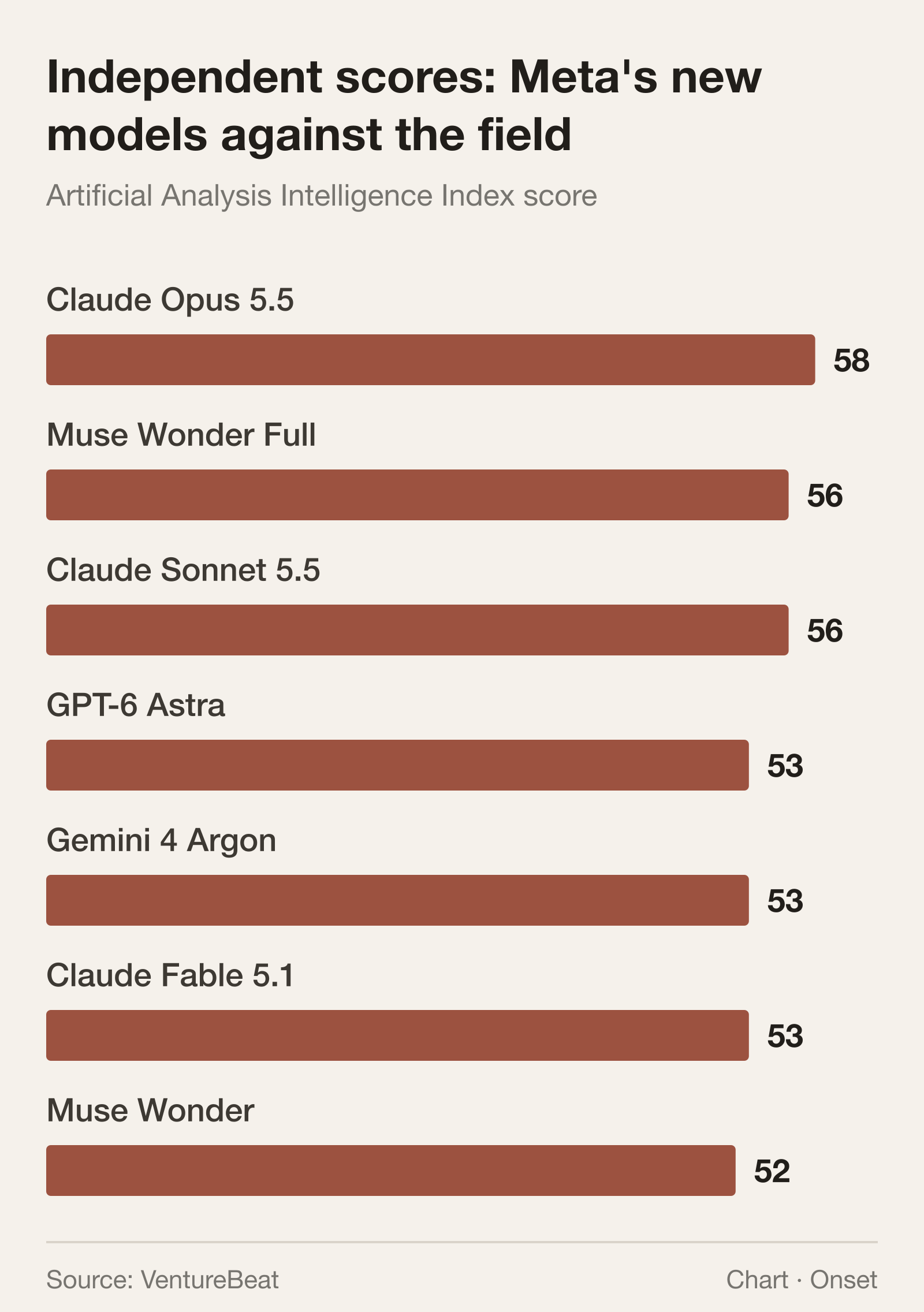
Independent testing puts Meta close to the top but not in first place. Artificial Analysis, which runs the same tests on every major model, gave Muse Wonder Full a score of 56 on its Intelligence Index and the standard Muse Wonder a 52. That ties Wonder Full with Anthropic's Claude Sonnet 5.5 and puts it ahead of OpenAI's GPT-6 Astra and Google's Gemini 4 Argon, which both scored 53. Anthropic's Claude Opus 5.5 still leads at 58.
The release matters because Meta had fallen behind. Its AI work slumped badly enough that the company went on a hiring spree, according to The Information. In August of last year, Mark Zuckerberg reorganized the effort under Alexandr Wang, the founder of Scale AI. Since then, Meta had put out only a lighter model, Muse Spark, and a Muse assistant. Wonder is the group's first attempt to match OpenAI, Anthropic and Google at the top. Zuckerberg called it "a much larger and more advanced class of models". The models were trained at Prometheus, Meta's large data center in Ohio.
It also completes a change in strategy. Meta's earlier Llama models were free for anyone to download and run. Neither Wonder model is.
Meta is selling the standard Wonder model to developers at $4 per million input tokens and $20 per million output tokens, the same price as Claude Opus 5.5. A per-token price doesn't tell you what a job costs, though, because some models use far more words to get to an answer. Artificial Analysis found that Wonder used 130 million output tokens to run its tests, compared with a median of 85 million for similar models. That works out to $4.52 for an average task, less than Opus 5.5 at $5.98 but more than GPT-6 Astra at $3.26.
The stronger Wonder Full is not sold to developers. It is available only inside Muse Code, Meta's coding assistant, on plans that cost $50 or $200 a month. Those plans let Meta train on users' code and prompts unless the user turns that off.
Meta's own charts show Wonder Full ahead on long coding projects and legal work and behind Opus 5.5 and GPT-6 Astra on terminal and health tests. VentureBeat noted that some of those comparisons mix Meta's own tests with numbers supplied by other companies.
Early users have been posting what the model built for them. One user gave it a one-line request for an interactive web scene "inspired by" the artist Olafur Eliasson and got this. Wang reposted it, writing "that's pretty cool!"

Finally got one decent output from Muse Wonder I tried to keep the prompt really simple so it can be creative "Create an exceptionally beautiful, interactive Three.js experience inspired by the artistic principles behind Olafur Eliasson's exploration of natural phenomena." And this is what it built 👀
Meta says it trained the models to avoid sharing private information without permission and to refuse harmful requests. Its full safety report "will be available soon". Muse Wonder will next power Meta's Muse assistant, starting with paying subscribers. Arena, a site that ranks models by user votes, says its scores for Wonder are "coming very soon".