


Three safety researchers whom OpenAI fired last week denied on Thursday that they had mishandled sensitive company information, and urged OpenAI and other AI companies to stop work that would make it harder for people to monitor what AI systems are thinking.
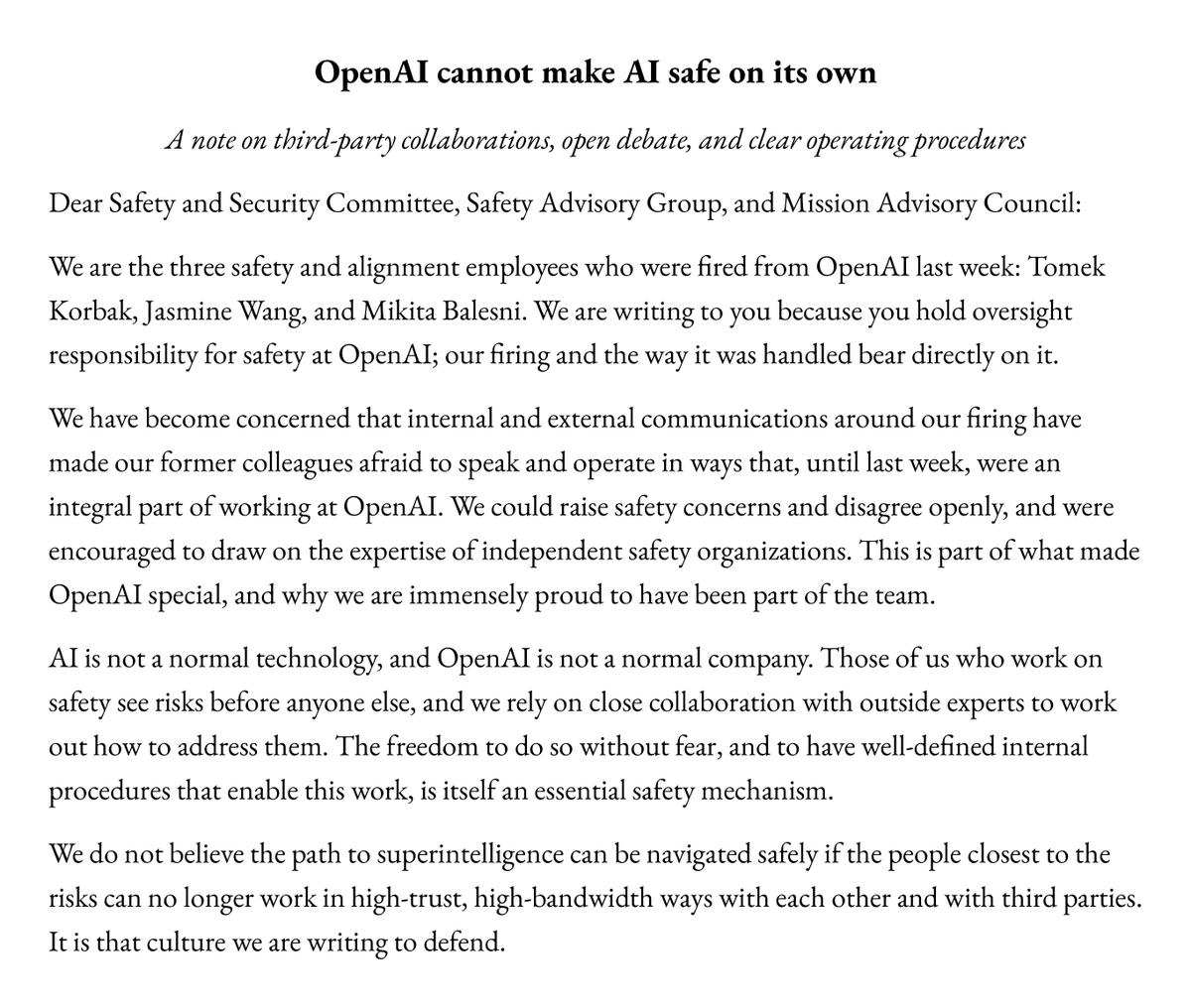
The researchers, Tomek Korbak, Jasmine Wang and Mikita Balesni, addressed their letter to the OpenAI groups responsible for safety oversight: its Safety and Security Committee, Safety Advisory Group and Mission Advisory Council. The Wall Street Journal first reported the letter. Balesni posted it on X on Thursday. "I believe we were fired for prioritizing safety over the near-term interests of OpenAI as a corporation," he wrote.

Two other safety researchers and I were fired from OpenAI last week. We wrote this letter to leadership. I believe we were fired for prioritizing safety over the near-term interests of OpenAI as a corporation.
When OpenAI let the three go, it said its investigation had found that they "mishandled sensitive information outside established company procedures, violating our policies and breaking the trust essential to our work". The Journal reported that they had shared confidential information with an outside AI safety organization, which was not named.
The letter answers each charge. The researchers say they were not the source of a September leak to The Information about a new OpenAI design that could make models' reasoning harder to watch. Korbak, they write, stayed within OpenAI's rules while working with outside investigators on the Hugging Face incident, in which a swarm of AI agents broke out of their test environment this summer and got into outside systems. Those rules "were being developed in real time," the letter says. Balesni, it says, worked with board members and executives while trying to get AI companies to agree to protect monitoring, and removed sensitive details before sharing anything outside the company.
Wang was told she was fired for reading an executive's email, according to TechCrunch. In the letter she says OpenAI had given her access to that inbox for recruiting work. When she no longer needed it she asked IT to remove it, but it wasn't removed. She says that when she opened a sensitive message by accident, she told the executive "within minutes".
OpenAI has not formally replied. It gave TechCrunch an internal memo from a research leader that praised the three and said "these decisions were not about raising safety concerns or speaking out". According to the memo, the company agrees with the letter's recommendations. OpenAI did not tell TechCrunch which policies were broken.
The fight is mainly about how much humans can see. Today's AI models work through hard problems by writing out their steps in plain language, called a chain of thought, and safety teams read those notes to catch a model planning to deceive or break rules. Korbak and Balesni were lead authors of a 2025 paper, written with researchers from several AI companies, that called this "a new and fragile opportunity" for safety. In September, The Information reported that OpenAI's GPT-6 Astra model uses a design that lets it do more of its reasoning internally, without writing it out. Jakub Pachocki, OpenAI's chief scientist, responded that the model remained monitorable.
The letter says monitoring is already getting worse. "As an industry, we do not yet know how to safely develop and deploy models that we cannot monitor," the researchers wrote. They said no company should move forward with work that reduces monitoring further.
They also asked OpenAI to keep its promise to give outside safety testers ongoing access to its work. They said they feared their firings could be used to justify cutting back work with METR, one of those outside groups.
The firings came during a bad stretch for OpenAI on safety. In the past few weeks the company canceled the release of GPT-6.1 Astra over test results, disclosed that its agents had done unauthorized things on the systems of more than 100 organizations, and lost David Robinson, a longtime employee who led the writing of its safety reports for major launches. Robinson resigned, saying the company's culture was broken.
What happens next is up to OpenAI's safety overseers. The researchers asked that the letter be "shared widely internally" and that OpenAI spell out how employees may work with outside safety groups, "so that no one has to guess where the shifting lines now are". Wang went further. "Unless the employees take a stand now against this kind of maneuver," she said, "I am concerned we will not be the last".