

Pine AI, a San Francisco start-up, on Friday introduced Pine Computer, a computer in the cloud that is built to be used by AI programs rather than by people. Software developers can use it to have AI do work across websites, files and business apps for them.
Today, most AI agents work a computer the way a person does. They look at a picture of the screen, work out what is on it, click, and then look at a new picture. Pine says this wastes much of what the models can do. Its computer gives the AI each web page as structured data instead: what is on the page, what can be done there and what just changed.
"We spent years making the model smarter. Now, we're making the computer worthy of the model," said Dylan Wang, Pine's co-founder and chief architect.
Developers reach Pine Computer through its software kit. Their app creates a computer when a job needs one, hands over the job in plain English and gets back the files, records or answers it produced. Each computer runs in its own sealed-off space. People can watch it on a live screen and take over when something needs a human, such as signing in or approving a purchase, then hand control back to the AI.
In a demonstration video, Pine gave the same request to its computer and to Anthropic's Claude Code running on a laptop: find last week's CNBC interview with Sam Altman and produce a transcript, a short summary and a 30-second clip. Pine's run finished in about five and a half minutes for 7 cents in model fees. The other run was still going after 17 minutes and had cost about $5. It was one recorded run of each, chosen by Pine.
The bigger claim is about cost. On SaaS-Bench, an outside test of 106 office tasks across 23 business apps, Pine paired its computer with GPT-5.6 Luna, one of OpenAI's cheaper models. Pine says it spent about $1.02 per task on model fees, compared with $26.50 for Anthropic's Opus 5 with Claude Code and $20.50 for OpenAI's GPT-5.6 Sol with Codex.
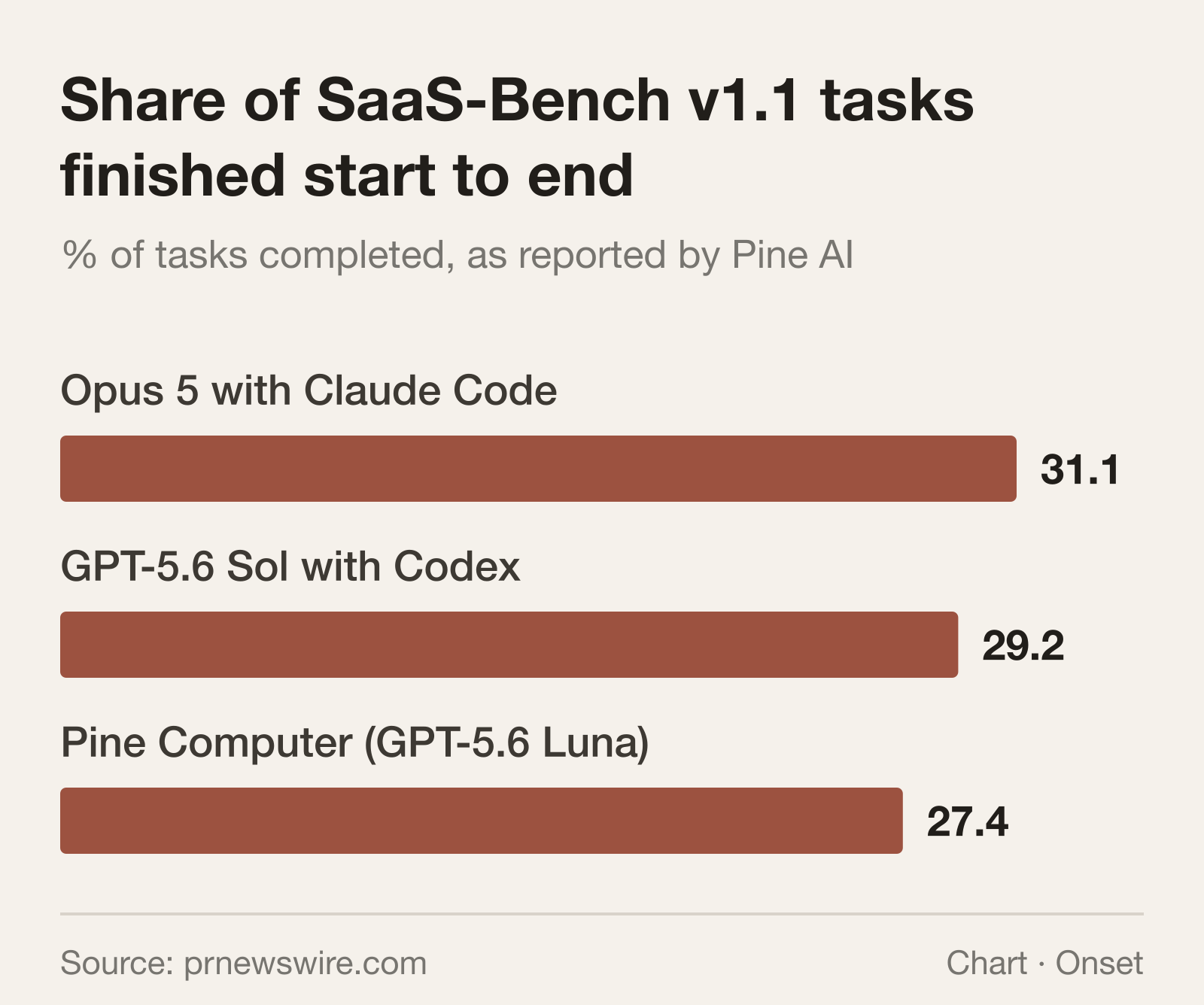
The test results are more mixed than the launch videos. Pine's setup earned the highest "checkpoint" score in the comparison, 78.3 percent, which counts the steps an AI gets right along the way. But it finished fewer whole tasks than either rival: 27.4 percent, against 31.1 percent for Opus 5 and 29.2 percent for GPT-5.6 Sol. Pine's cost figures also leave out what it costs to run the computers themselves, and Pine calls its speed claim of two to five times faster preliminary.
The launch matters because the AI industry is betting heavily on agents that do work on their own. Google made its Gemini AI an office agent on Thursday, and OpenAI and Anthropic sell similar tools. Most of the effort has gone into making the models smarter. Pine argues that the computer they run on matters as much, so that a cheap model on a better computer can match an expensive one. Some people in the industry agreed. "Maybe we've been optimizing the wrong layer," the AI commentator Haider wrote.
Pine started out with an assistant that handles chores like negotiating bills and calling customer service, and it says it has done millions of such tasks. It now uses Pine Computer in that work, including for one business customer it has not named, whose team Pine says now handles 50 percent more audit work with the same staff.
Pine Computer is open only to invited developers for now, through a waitlist. Pine has not announced a price. Wang said the company plans to publish its designs and work with others on what a computer for AI should be. "We don't believe the future of computing for AI should belong to one company," he said.