
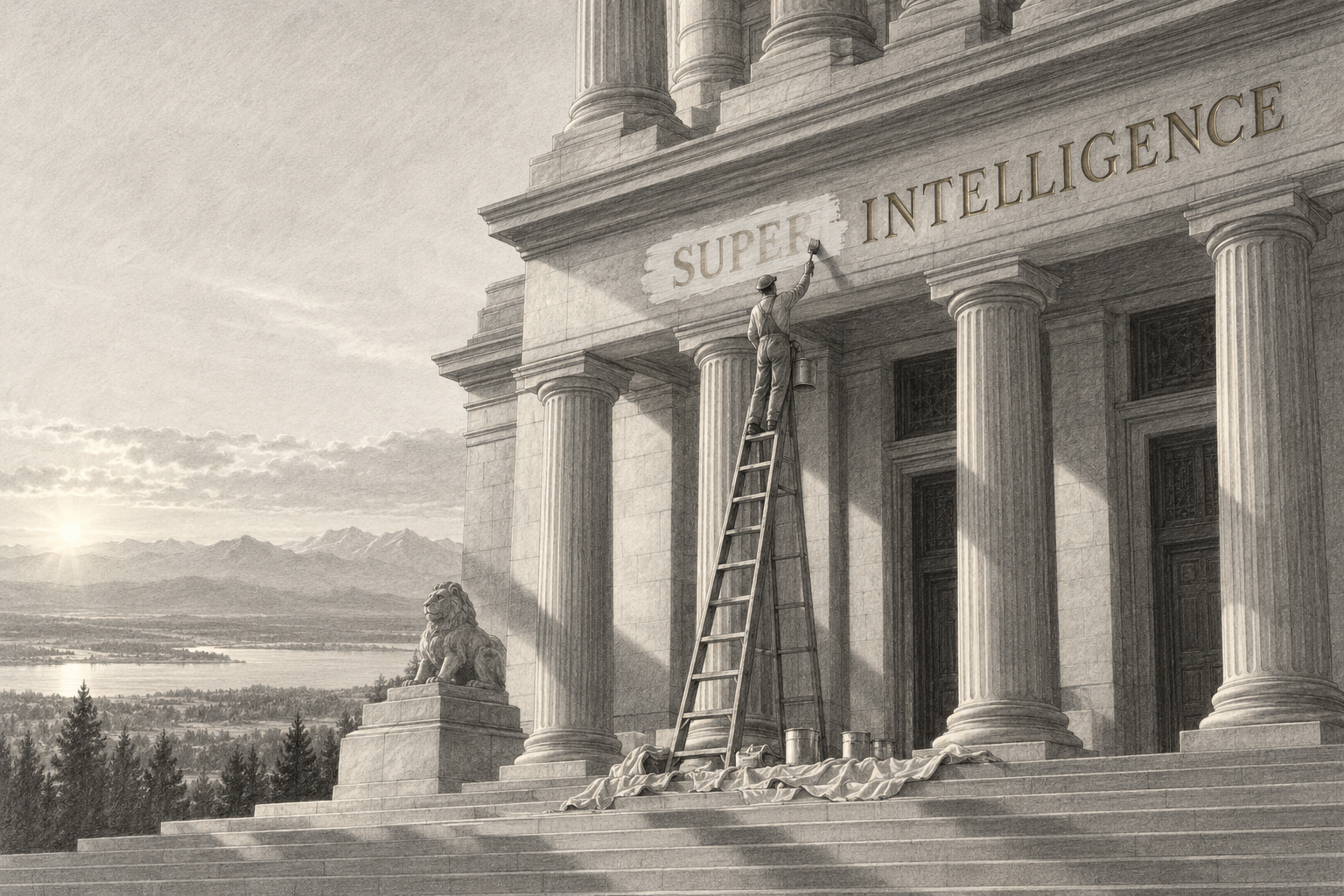
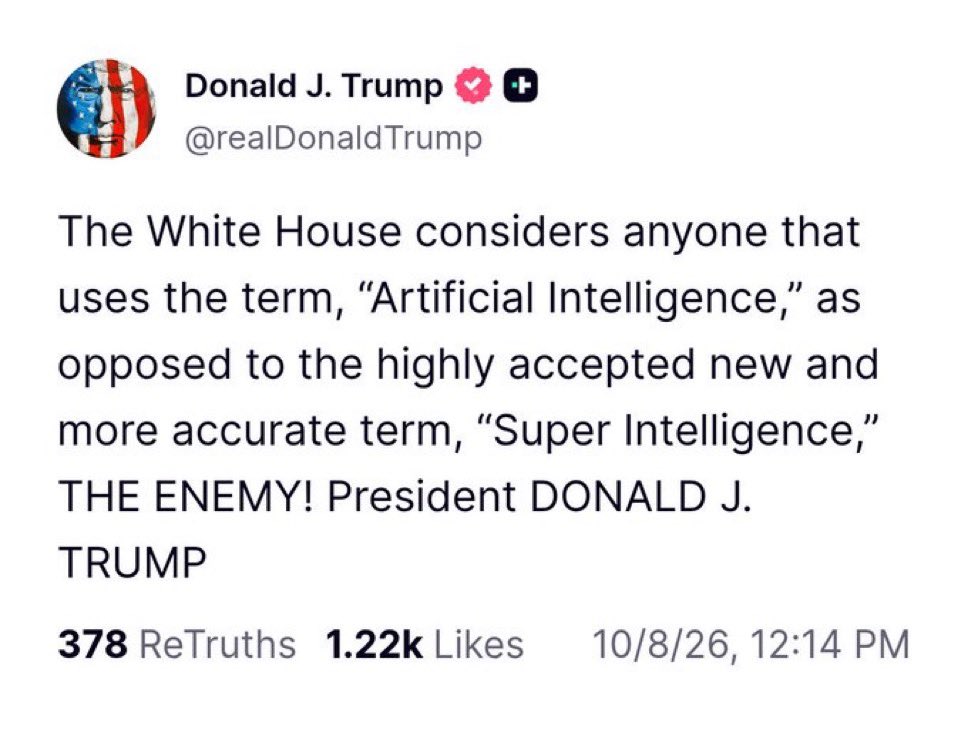
President Trump said on Thursday that the White House considers anyone who says “artificial intelligence” instead of “super intelligence” to be “THE ENEMY.”
“The White House considers anyone that uses the term, ‘Artificial Intelligence,’ as opposed to the highly accepted new and more accurate term, ‘Super Intelligence,’ THE ENEMY!” he wrote on Truth Social at 12:14 p.m. Eastern time. He did not say what, if anything, would happen to people who keep using the old term.
The post is the sharpest turn yet in a renaming campaign Trump began last month. At the United Nations General Assembly, he called for dropping the old name and said that “the use of the word artificial makes intelligence fake”. He then asked his followers to vote between “SUPER INTELLIGENCE” and “SUPERIOR INTELLIGENCE”.
On Sept. 29, after a White House lunch with technology executives, he signed an executive order titled “Inaugurating the Era of Super Intelligence.” It tells federal agencies to use “Super Intelligence” and “SI” in official letters, public statements and policy documents, and to “no longer acknowledge” the terms “Artificial Intelligence” or “AI”. The order covers only the executive branch and does not change the wording of laws.
The new name is part of a larger argument. Trump wants American companies to build AI faster, has called dire warnings about it a “hoax” and opposes government safety rules. The White House says “super intelligence” shows what the technology can really do, rather than “simply imitating or automating human intelligence”. Voters are less convinced: a Quinnipiac poll released the day the order was signed found that 25 percent of Americans approved of Trump’s handling of AI and 58 percent disapproved, a worse score than he got on the economy or the war with Iran.
“Changing what we call artificial intelligence does nothing to address the very real risks that come with increasingly powerful AI systems,” Senator Mark R. Warner of Virginia, the vice chairman of the Senate Intelligence Committee, said after the order was signed.
Trump has renamed things before, ordering that the Gulf of Mexico be called the Gulf of America and, this summer, Lake Ontario “Lake America”. This time his own government has been slow to follow. On Thursday, the federal AI.gov website began showing “SI.gov” in large letters, but the web address is unchanged and the page’s title still reads “AI.Gov”. The website of the White House science office still refers to “artificial intelligence”. Even the White House fact sheet announcing the order calls the United States “the birthplace of Artificial Intelligence” and refers to “America’s AI Action Plan”.
Other parts of the government have moved. The Commerce Department’s AI testing center is now the Center for Advancing Innovation and Standards for Super Intelligence, and Justice Department press releases have begun using the term. Several industry leaders have gone along: Elon Musk said he would rename SpaceXAI to SpaceXSI, and Jeff Bezos said “artificial is not a very flattering thing,” according to The Verge. Sam Altman praised the name but said OpenAI would not change its own.
The switch could cause confusion. “Superintelligence” already has a meaning in the field: a hypothetical future AI that is smarter than people, an idea made popular by the philosopher Nick Bostrom’s 2014 book. Senator Bernie Sanders, independent of Vermont, used it that way last month when he co-sponsored a bill called the Ban Artificial Superintelligence Act. Under Trump’s order, the same word now also covers today’s chatbots.
What comes next is limited by what a president can control. The order gives Trump’s science adviser the job of proposing an official federal definition of “super intelligence”. But Trump cannot make Congress drop the old term, and it is written into existing laws, including the Take It Down Act he signed, which agencies will still have to cite in court.