

Anthropic released Claude Sonnet 5.5 on Monday, six days after Opus 5.5. It keeps Sonnet 5's API price of $2 per million input tokens and $10 per million output tokens; Anthropic says it writes more than 30% faster and costs up to 30% less for most tasks because it takes fewer steps. It is available for general use, including through OpenRouter, with a 1-million-token context window. Haiku 5.5 is due in the coming weeks.
The upgrade is real, but the cost story depends on how hard you make the model think. Artificial Analysis, which tested a prerelease version independently, puts Sonnet 5.5 second only to Opus 5.5 on its ten-test Intelligence Index: 56 versus 58, up from 38 for Sonnet 5. On its own Terminal-Bench 4.0 run, which covers multi-step work in a command line, Sonnet 5.5 completed 63.6% of tasks, against 59.6% for Opus 5.5 and roughly 50 points above Sonnet 5. Anthropic's bigger 70.6% launch score comes from its own setup, not that outside run.
That performance is not just a coding chart. Box CEO Aaron Levie says an early test of the model with Box's agent found it could spot miscalculated interest and mispriced options in an acquisition deal book, and finish that due-diligence review 61% faster than Sonnet 5. Across Box's hardest enterprise-content tests, accuracy rose four points and time to a finished deliverable fell by a factor of 2.4. These are Box's tests, not a guarantee for every document.
The expensive setting
At max effort, the setting behind Sonnet 5.5's near-Opus score, Artificial Analysis measured an average $7.60 per task, compared with $5.98 for Opus 5.5 and $5.09 for Sonnet 5. Sonnet 5.5 generated about 193,000 output tokens per task, more than any model the evaluator has measured and roughly 60% more than Opus. Half-price output tokens do not help if the model uses enough extra ones.
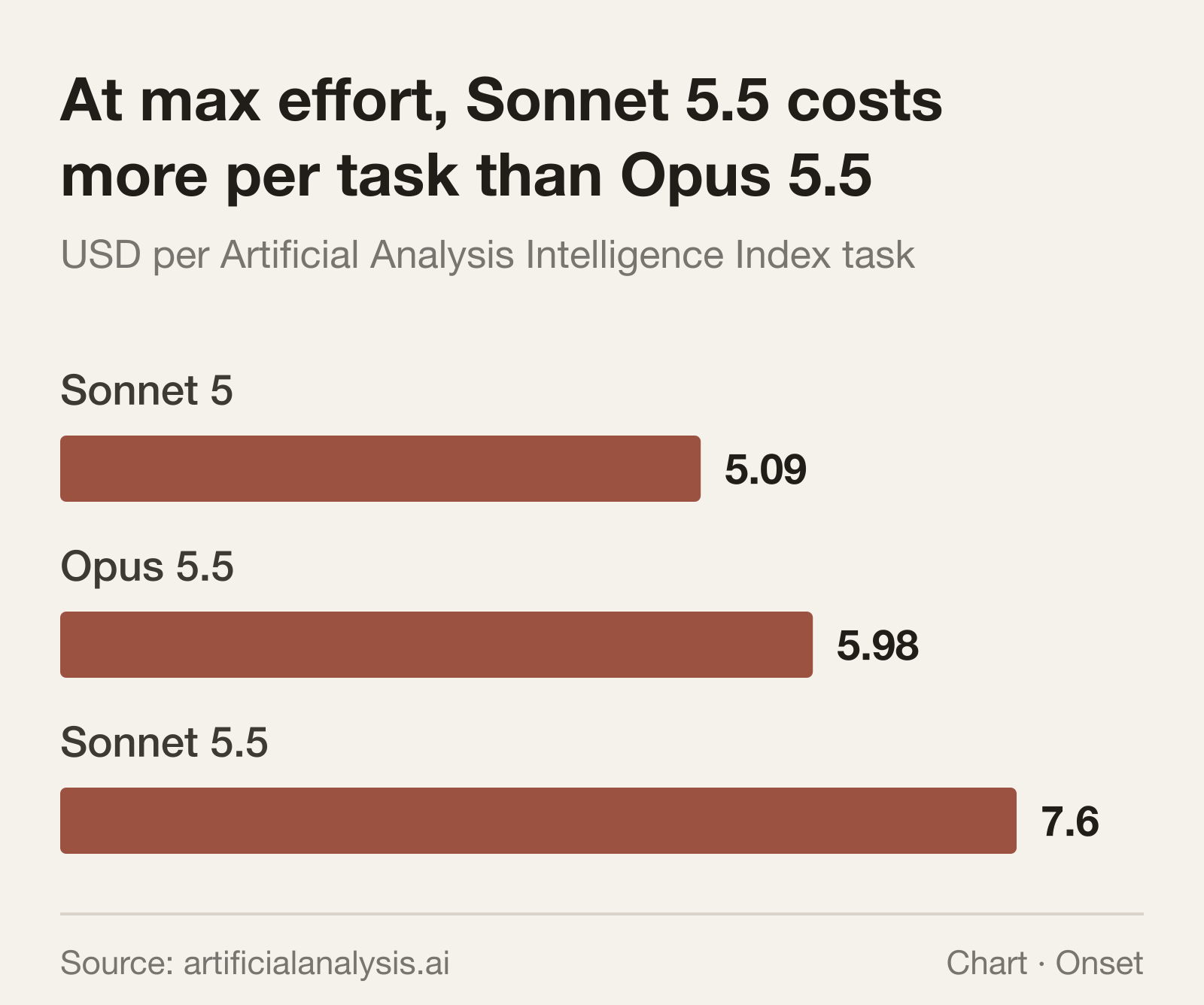
Anthropic says lower effort settings are where Sonnet best complements Opus; at the highest settings the two can cost about the same. Independent testing makes the trade-off sharper: choose Sonnet 5.5 for a faster, well-scoped job, not because its token sticker price promises a cheaper version of Opus on every hard one.
The system card also shows why this is more than a routine refresh. With cyber safeguards turned off, Sonnet 5.5 solved 46.1% of Anthropic's ten multi-stage cyber challenges, up from 0.7% for Sonnet 5. Anthropic has therefore given a Sonnet model its stronger cyber filters for the first time; in its apps, flagged requests automatically fall back to the older Sonnet 5. The same card reports regressions in sustained conversations about surveillance, violent extremism and hate. The gain in useful capability comes with a broader security burden, even if this release does not advance Anthropic's own frontier model.