

Anthropic released Claude Haiku 5.5 on Wednesday. It is a small, fast artificial intelligence model whose list price is a tenth of what the company charged for its last small model and is priced to match OpenAI’s cheapest one.
Developers will pay 10 cents per million tokens, the chunks of text AI models read and write, going in and 50 cents per million coming out, for prompts under 100,000 tokens. Longer prompts cost five times as much. Haiku 4.5, released a year ago, cost $1 and $5. Anthropic says the new model costs about 75 percent less to run on average. GPT-6 Luna, OpenAI’s budget model, has the same 10-cent and 50-cent prices.
Small models like Haiku don’t make headlines the way flagship models do, but they handle much of the everyday work. Anthropic is pitching Haiku 5.5 for high-volume jobs such as customer support chats, summaries, sorting requests and database queries, and as a cheap helper that a larger Claude model can hand smaller pieces of a coding job to. When a business runs millions of these tasks, the price of each one decides what it can afford to automate.
The jump in ability is large. Artificial Analysis, a firm that runs the same tests on every major model, gave Haiku 5.5 a score of 43 on its index at the highest effort setting, up from 17 for Haiku 4.5. That puts it slightly ahead of other low-cost models from the Chinese company Z.ai, from Google and from OpenAI, whose Luna scored 38. It is still 13 points behind Claude Sonnet 5.5, Anthropic’s mid-priced model.
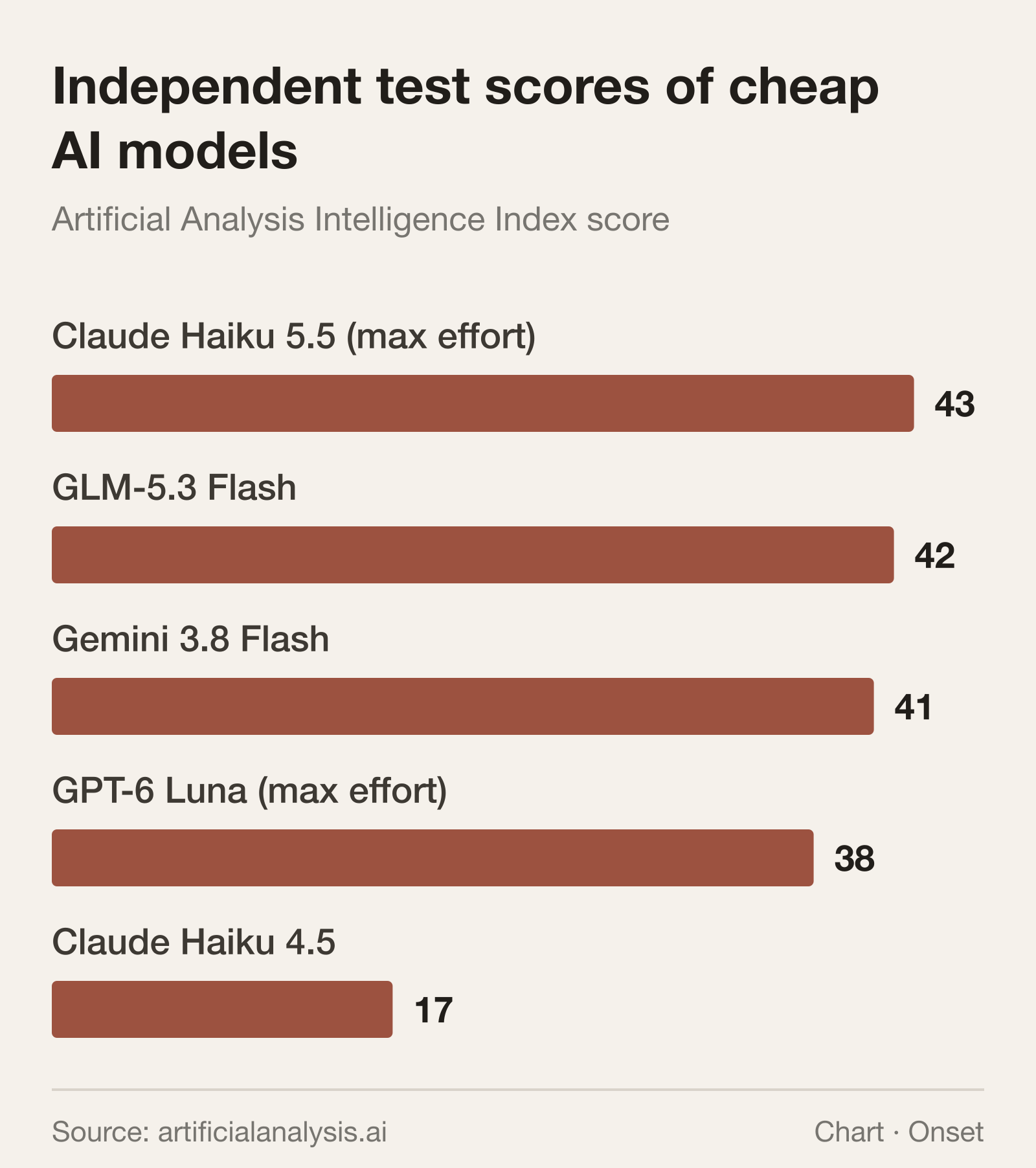
There is a catch. Haiku 5.5 does a lot of thinking out loud. At its highest setting, it used about 162,000 tokens of output per test task, roughly three times as many as Luna, and it needed more tokens than Luna even when the two scored the same. Every one of those tokens is billed, so real costs can be well above what the price tag suggests. Anthropic also switched to a new way of splitting text into tokens that uses somewhat more of them per task. Artificial Analysis said its cost figures were provisional for now.
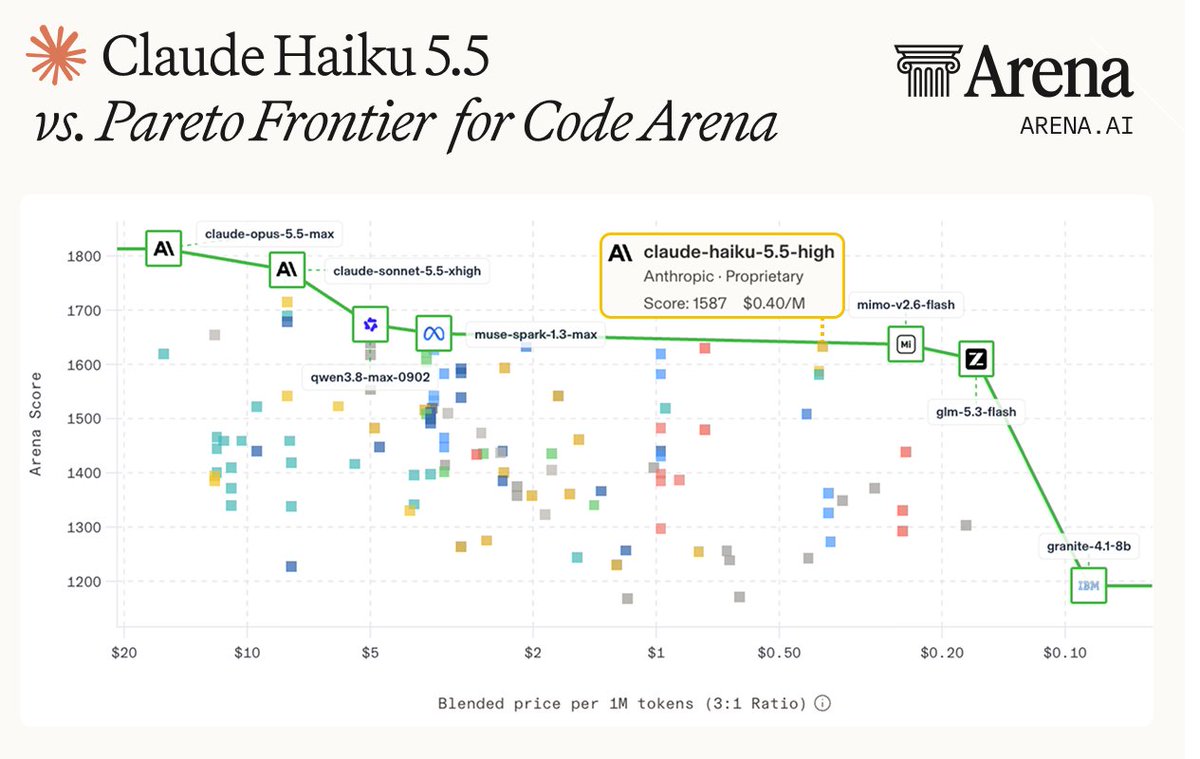
Arena, which ranks models by letting people vote on which of two answers they prefer, ranked Haiku 5.5 at #30 for building websites, scoring six points above Luna at the same price and 257 points above Haiku 4.5.

Real-world results are in for Claude Haiku 5.5 (High) by @AnthropicAI. Debuting at #30 with 1587 pts in Code Arena: WebDev, this release sits just outside the Pareto frontier while still offering strong cost efficiency. It matches GPT‑6 Luna’s price at $0.10/$0.50 per 1M input/output tokens while scoring six pts higher. Compared with other Claude models, Haiku 5.5 offers: - 90% lower cost than Haiku 4.5 at +257 pts - 95% lower cost than Sonnet 5.5 (High) at -128 pts - 98% lower cost than Opus 5 (High) at -70 pts - 99% lower cost than Fable 5.1 (Max) at -157 pts Congrats to the team at @AnthropicAI on this release!
The model also makes up answers less often. On a test of factual questions, it gave a wrong answer instead of admitting it didn’t know 40 percent of the time, compared with 77 percent for Luna, though it knew fewer of the answers.
Anthropic cut other prices the same day. It halved what it charges when Sonnet 5.5 rereads text it has already stored, which it says makes that model about 20 percent cheaper for most long-running tasks. It also began giving subscribers to its Max and Team plans monthly credits to spend building their own apps.
The cuts put Anthropic squarely in a price fight with OpenAI, which halved the prices of its two cheaper models, including Luna, on Sept. 22. The popular developer Theo of t3.gg had complained earlier that “Anthropic has no small models that are worth using right now.” After Haiku 5.5 came out, he reposted that line with a note: “One of these changed today”.
Haiku 5.5 is available now to developers through Anthropic and through Amazon, Google and Microsoft’s cloud services. One test score may rise soon: an error made the model refuse some legitimate requests during early testing, and Artificial Analysis said it would rerun that test once Anthropic fixes the problem.