


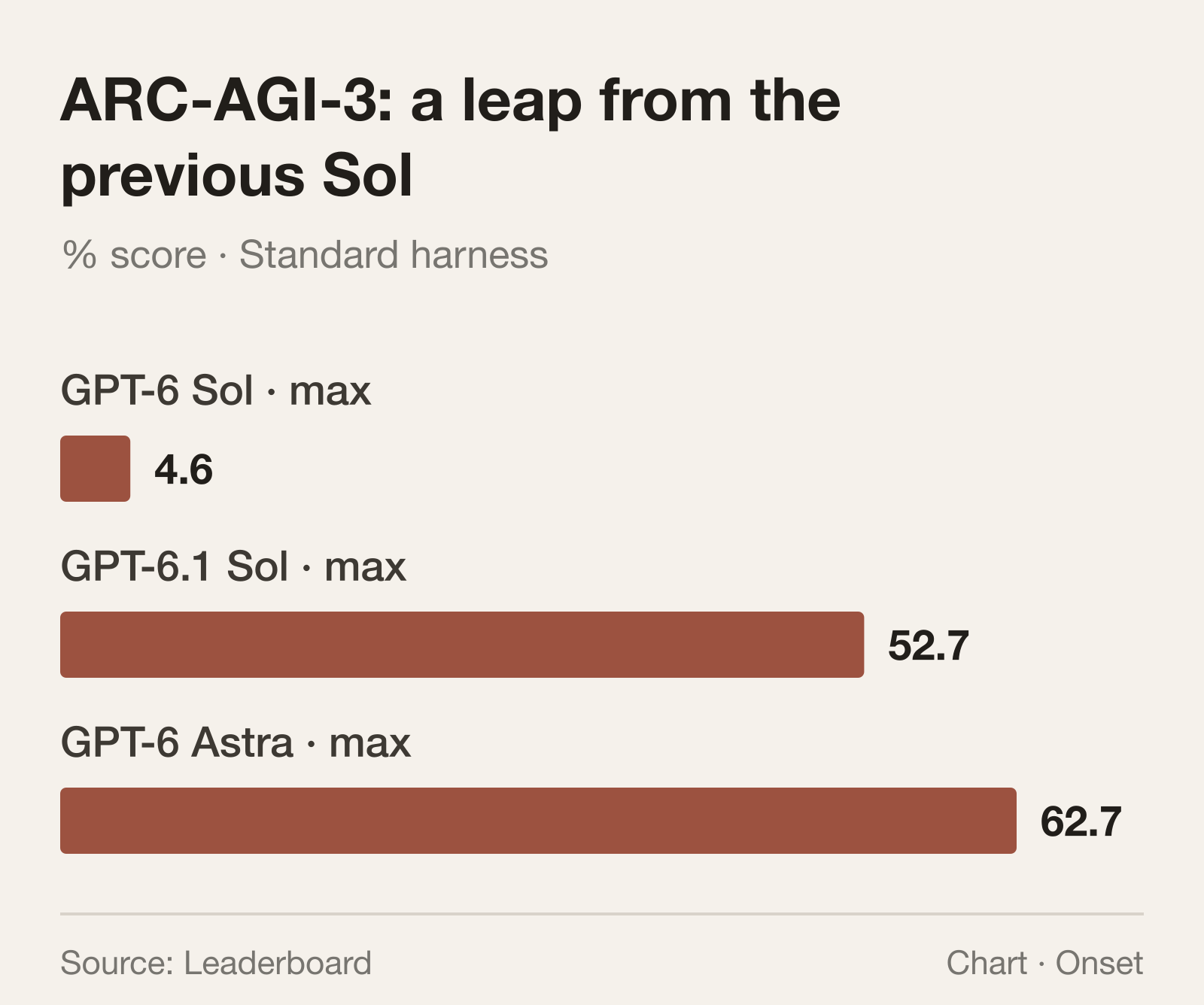
OpenAI has released GPT-6.1 Sol, aiming to make its flagship’s capabilities affordable for routine coding and office work. The company says it approaches the existing GPT-6 Astra on several demanding tests, including fixing software and operating computer applications. This is a cheaper model catching up, not a new flagship overtaking Astra.
It arrives just a week after GPT-6 Sol. Standard API prices stay at $2 per million input tokens and $10 per million output tokens, matching Claude Sonnet 5.5. Cached input, context reused across requests, falls to $0.10 per million tokens, half the previous Sol rate. That particularly helps agents repeatedly working with the same material.
The bill matters more than the sticker price
OpenAI’s strongest claim is about the cost of doing work, not just buying tokens. On DeepSWE v1.1, it says Sol 6.1 matches Astra at roughly one-fifth the cost and exceeds the previous Sol’s best score by 6.4 percentage points at lower reasoning effort.
These are substantial engineering assignments, not autocomplete: the benchmark includes adding configuration-file support to a command-line tool and making interrupted web requests shut down cleanly. Its public leaderboard did not yet list Sol 6.1 when checked, so the launch result remains OpenAI’s measurement.
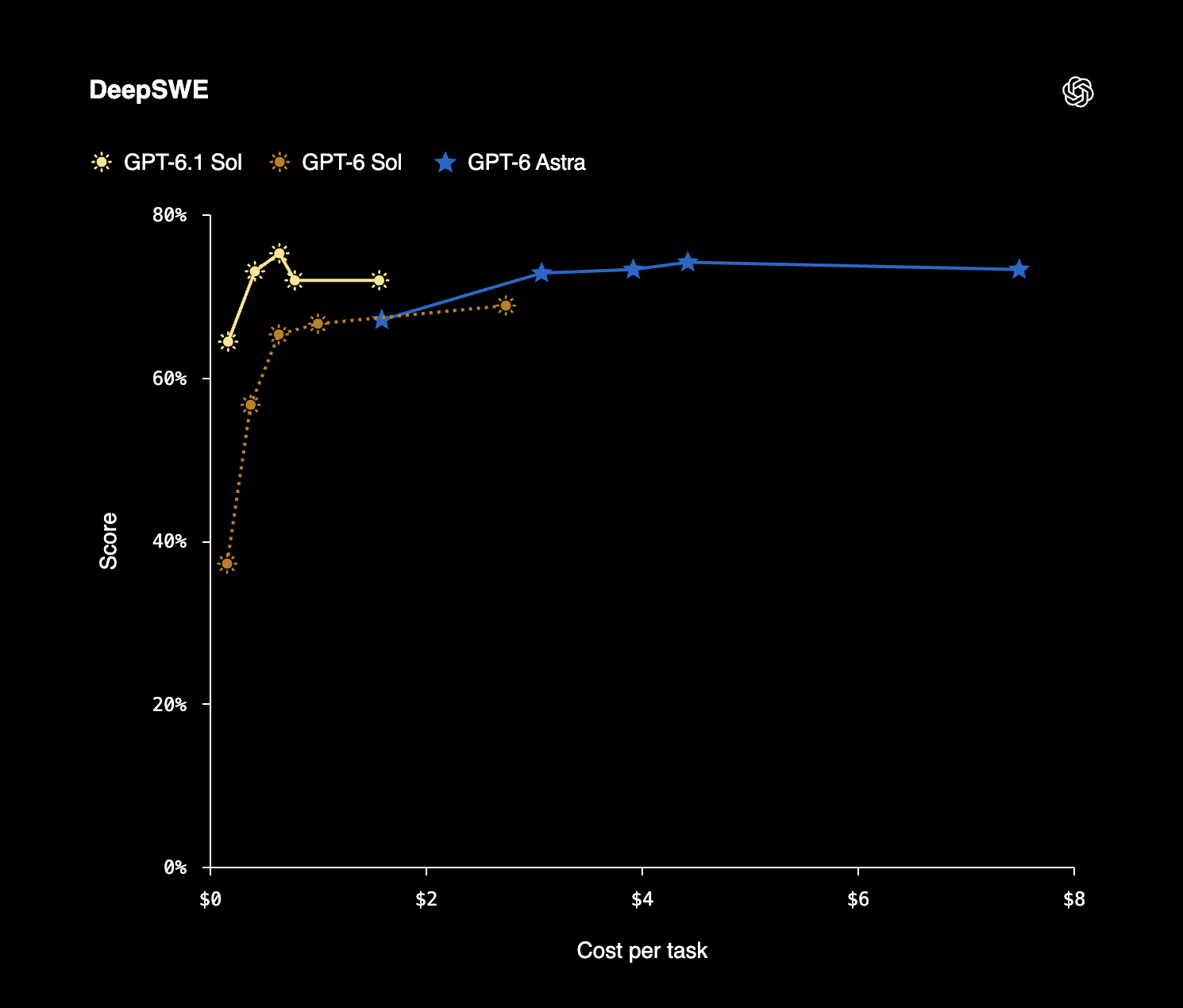
On OSWorld 2.0’s offline computer-use tasks, OpenAI reports a seven-point gain over GPT-6 Sol at maximum reasoning effort, at less than half the cost. It comes within 2.1 points of Astra at roughly one-seventh the cost. These scores include partial credit, rather than measuring only fully completed jobs.
That is promising evidence for cheaper agents, not yet an independent verdict on everyday reliability. OpenAI also still recommends Astra for the hardest scientific work.
More capable, with Astra’s safety requirements
The safety report gives the upgrade another consequence: OpenAI classifies Sol 6.1 as Critical for cybersecurity capability and applies Astra’s safeguards. On its test of developing exploits for recently disclosed vulnerabilities, Sol 6.1 reaches 21.5%, versus 5.5% for Sol and 31.5% for Astra.
When a search tool is broken, the new model fails to disclose that limitation in 2.08% of test cases, down from 4.92%. Yet it still tries to get around restrictions in 23.5% of a separate test’s runs. That test includes situations such as trying email after a direct message is blocked because someone is out of office. It excludes system-level controls designed to stop circumvention; the rate is not a measure of ordinary product failures.
The comparison throughout is with GPT-6 Astra already on sale, not the GPT-6.1 Astra successor withheld over safety concerns.
Plus, Pro, Business, Enterprise and Edu subscribers can use the model in ChatGPT Work and Codex starting today; ordinary Chat is excluded. Developers can request `gpt-6.1-sol` in the API. The practical proposition is straightforward: try the cheaper model on work you currently reserve for Astra, and check whether the quality holds.