
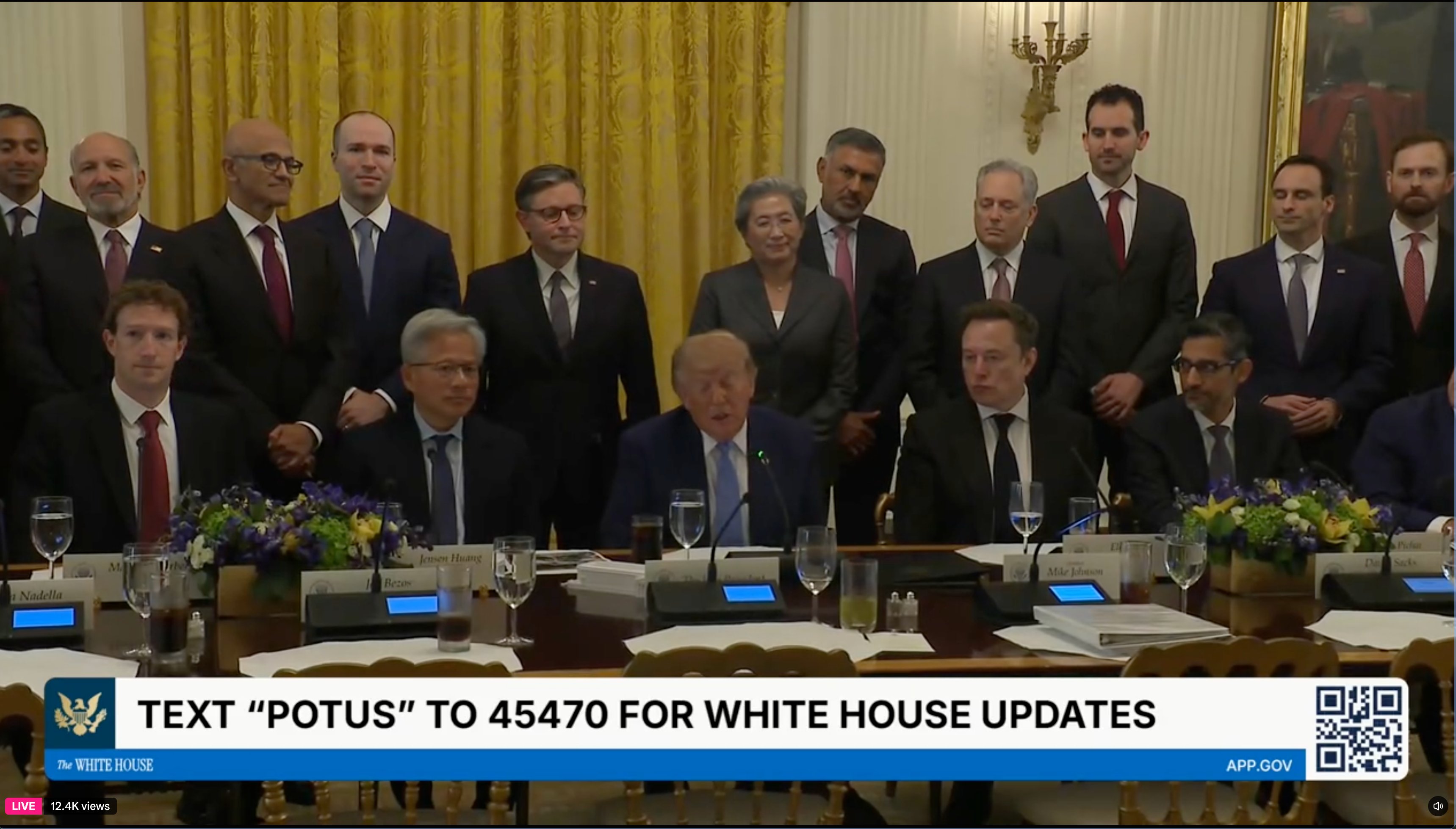
President Donald Trump said Tuesday that he and leading tech executives signed an AI accord he called “morally binding.” The agreement offers a structure for companies to check their own systems, rather than a new federal regulator to decide what they can build or release.
After the White House meeting, Trump emphasized self-regulation and pointed to the Justice Department and FBI as existing sources of oversight. He also floated a separate oversight committee; that remains an idea, not an announced operating body.
What companies are promising
Meta CEO Mark Zuckerberg described internal risk reviews, external auditors and evaluators, and independent review of their reports by company boards. Google CEO Sundar Pichai compared the approach to the financial controls companies already use.
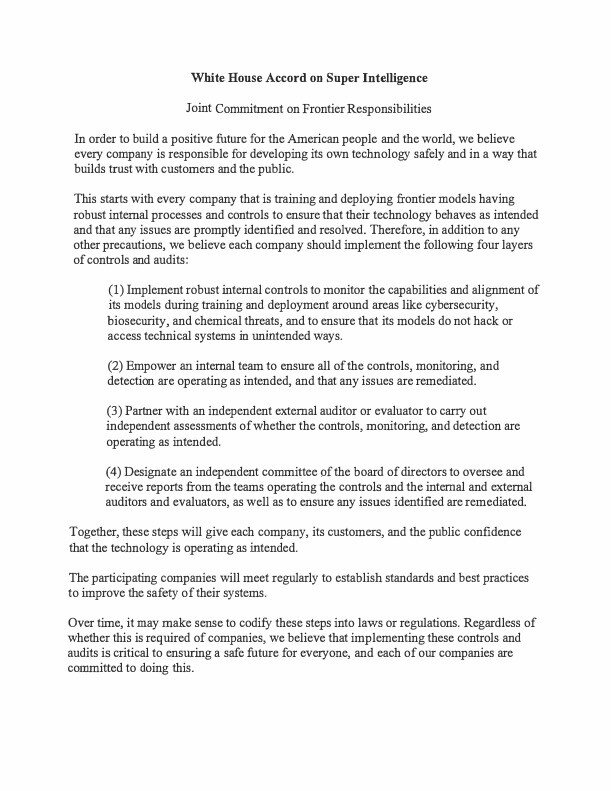
A one-page copy of the White House Accord on Super Intelligence, shared by Andrew Curran, spells out four layers. CBS separately reports that Trump posted the accord on Truth Social.
- Controls during training and deployment: monitor capabilities and whether models behave as intended, including cyber, biological and chemical risks and unintended access to technical systems.
- An internal checking team: ensure monitoring and controls work, and problems get fixed.
- An independent outside auditor or evaluator: assess whether those safeguards operate as intended.
- An independent board committee: receive reports from the teams and auditors and oversee fixes.
Participating companies also commit to meeting regularly to develop safety standards. The text leaves open turning these steps into laws or regulations later.
Audits are a promise, not proof of safety
The published copy does not name auditors, set implementation deadlines, require public release of their findings or specify penalties. Its reporting chain ends with company boards. That makes this a commitment to a review process, not evidence that the reviews have happened or that any particular model is safe.
Nor did the meeting settle the industry's disagreement about risk. Speaking beside Trump afterward, Anthropic CEO Dario Amodei said AI has “very real risks” and that how to address them remains under discussion. He urged working together to win safely, rather than declaring those concerns resolved.
The practical test is what happens when an outside auditor tells a company that its next model is not ready to release.